

The Himalayan Adventures
Manaslu
Close Encounters with a Himalayan Giant
THE WELL DEFINED and fully documented routes to Everest Base Camp and those around the peaks of the Annapurna range are the obvious magnet for the ‘once in a lifetime’ visitors to Nepal. But the real challenges and experiences are to be enjoyed elsewhere, often in the remoter and undeveloped parts of the country and amidst truly wild and magnificent mountain scenery. It was on such an adventure that I set out in search of a rarely used route in the Manaslu Himal, but the trip certainly did not turn out quite the way I had expected.
It is easy to be ambitious when planning your itinerary on the map, surrounded by the comforts of home and in front of a nice warm fire. But you take a different view when you come face to face with the reality, particularly when that is in a white-out on a Himalayan pass, miles from anywhere, and a gale force icy cold wind is blasting past your ears!
I ruefully remembered and pondered over the words with which I had encouraged others to accompany me on this trip – “the view from the Rupina La will be superb, chaps” – as I peered into the mist and began tentatively to descend the steep icy slope below me into the Chhulung valley.
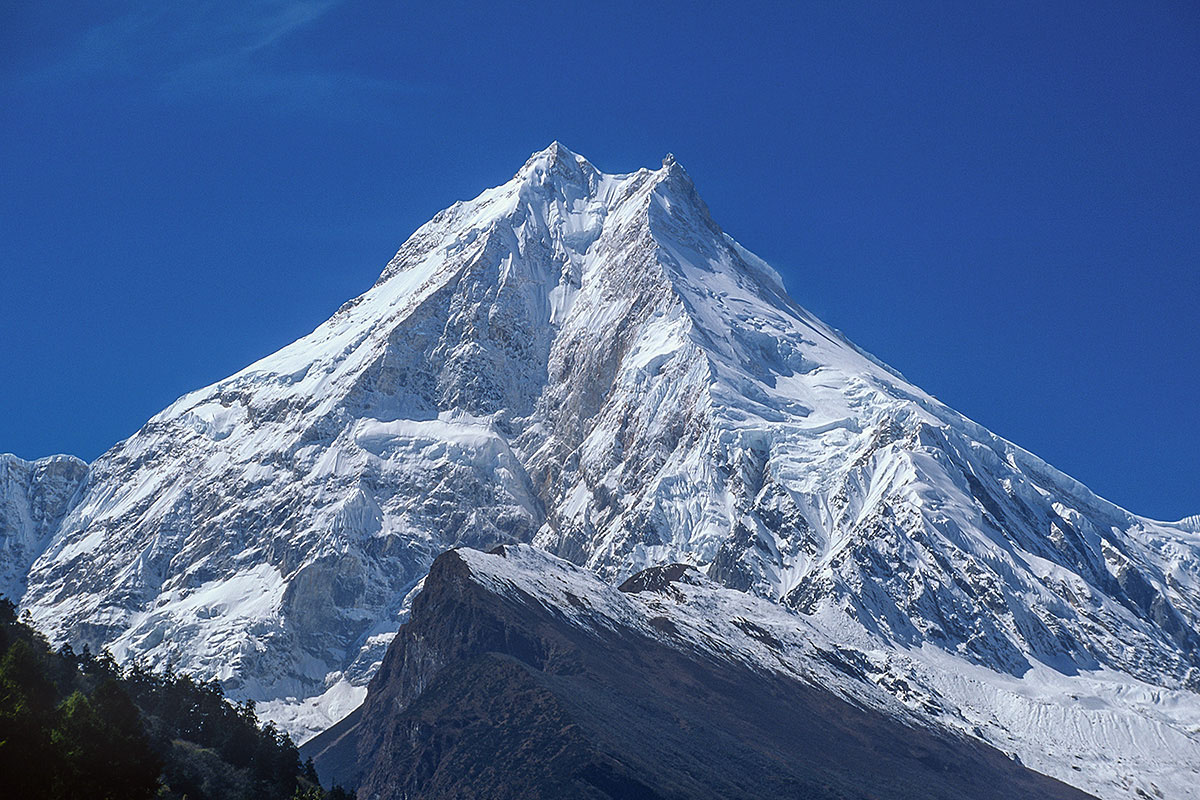
The mighty East Face of Manaslu from near Lho
The Rupina La pass looked an inviting objective on the map – a challenging variant to the accepted and lengthy approach up the valley of the Buri Gandaki. I knew that better men than I had failed even to find this pass, but crossing it would lead us quickly and directly to the very heart of a complex ring of high and elusive mountains, hidden away beneath the giant peak of Manaslu in central Nepal.
Despite Manaslu’s magnificence of form and status as the world’s eighth highest mountain, only a handful of visitors ever come this way. Those who do usually circumnavigate the entire Manaslu Himal, a journey which climaxes with the crossing of the 5300 metre Larkya La pass. As well as offering superb views of Manaslu, the route also passes directly beneath the outlying peaks of Himal Chuli and Ngadi Chuli – both of which rise to nearly 8000 metres.
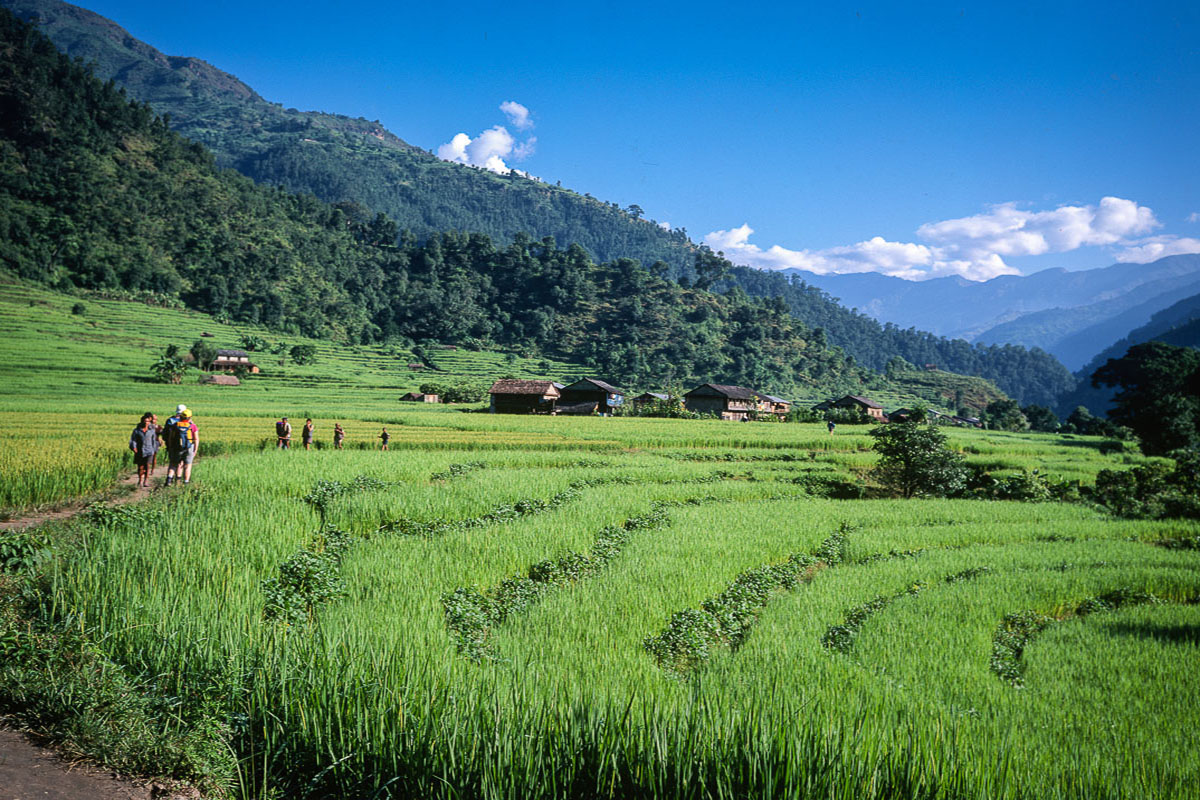
Terraced Fields of the Dorandi Khola Valley
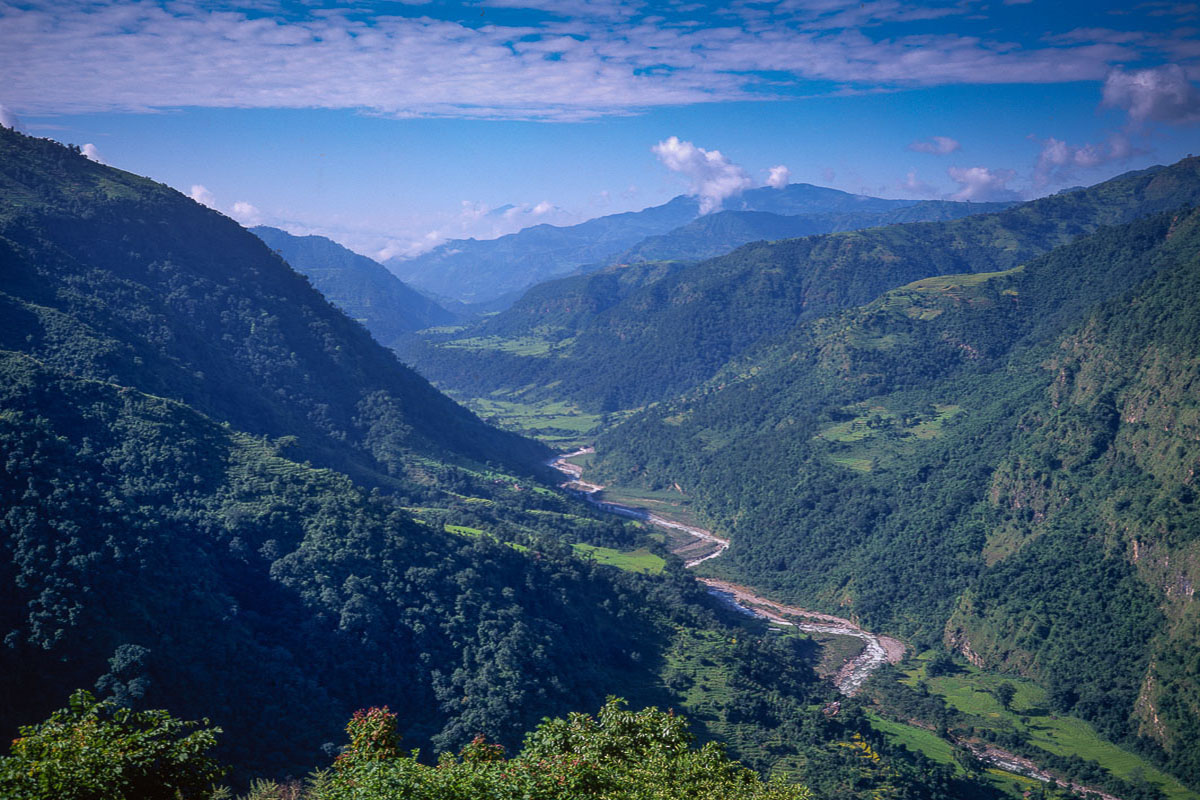
The Dorandi Khola from the ascent to Barpak
The team was in excellent spirits as we enjoyed a fine panorama of the Annapurna and Manaslu Himals from our first camp on a ridge near Gorkha, above the Dorandi Khola valley. But joy turned to alarm when we realised that the ground was infested with leeches, and battles then raged throughout the night against these cunning wriggling creatures. Bed tea was eagerly received at 5.30 am next morning, and we wasted no time in getting away down the trail.
The first few days of our expedition were then spent in the steamy heat of the valley below, following a meandering path beside the Dorandi Khola, through sleepy Brahmin villages and terraced fields of rice and millett. Then, suddenly, the way was up, past more terraces, and through the prosperous village of Barpak, the last permanent settlement we would encounter for nearly a week.
I had some doubts about the tiny trail that climbed steeply up onto a great ridge, at first across open scrub, but then through rhododendron, maple and fir forest. It certainly was not the route I had planned, nor was it shown on my rather crude map. But my Sherpa sardar Tenzing said he had been to the area before and he assured me that he felt it was the best approach to the pass. His experience proved to be invaluable, for the Rupina La remained stubbornly hidden from view beneath a persistent build-up of what turned out to be heavy snow-bearing cloud.
We were beginning to enjoy the ridge when Tenzing beckoned us steeply down, through dense forest, on a tenuous trail that had us swinging from branches, clambering over contorted root systems, sliding down muddy banks and extracting ourselves from deep peaty morasses. We finally stumbled into a high open valley surrounded by steep cliffs. A few bare platforms scraped out of rough ground at about 4000 metres was all that marked the site of what Tenzing proudly announced was ‘Rupina Base Camp’.
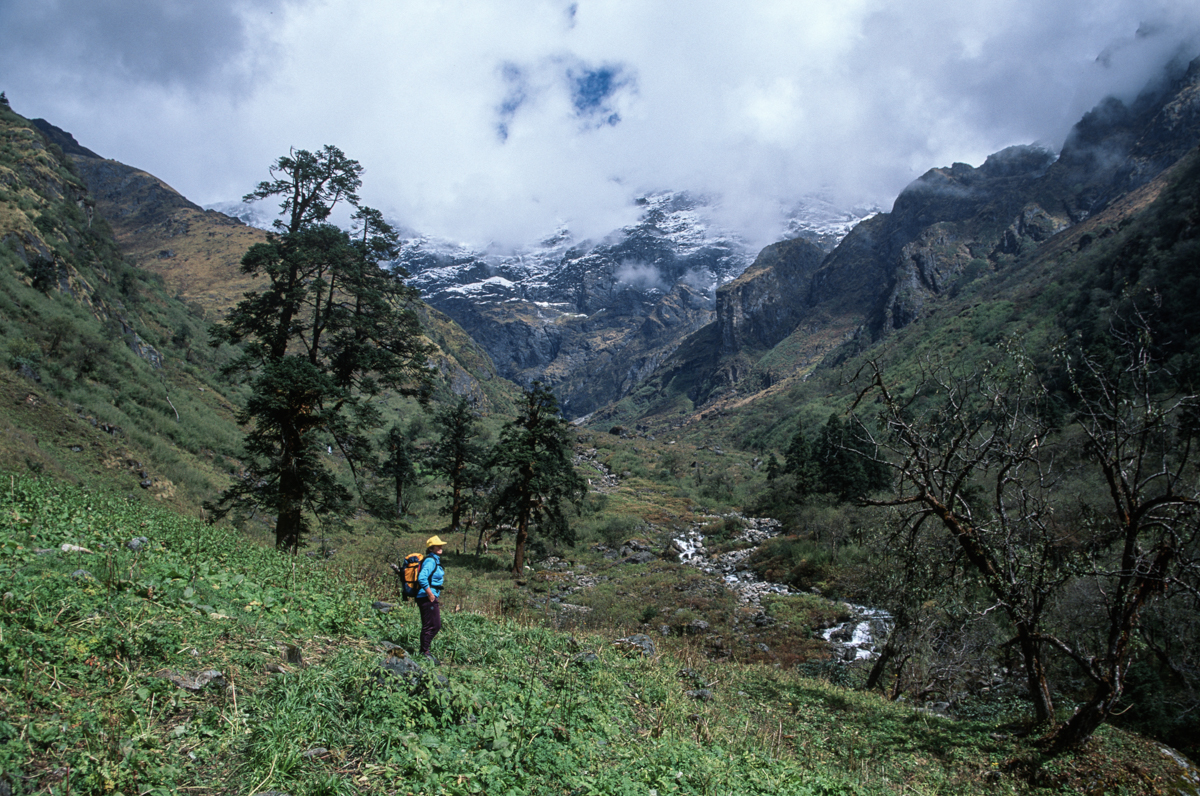
‘Rupina Base Camp’
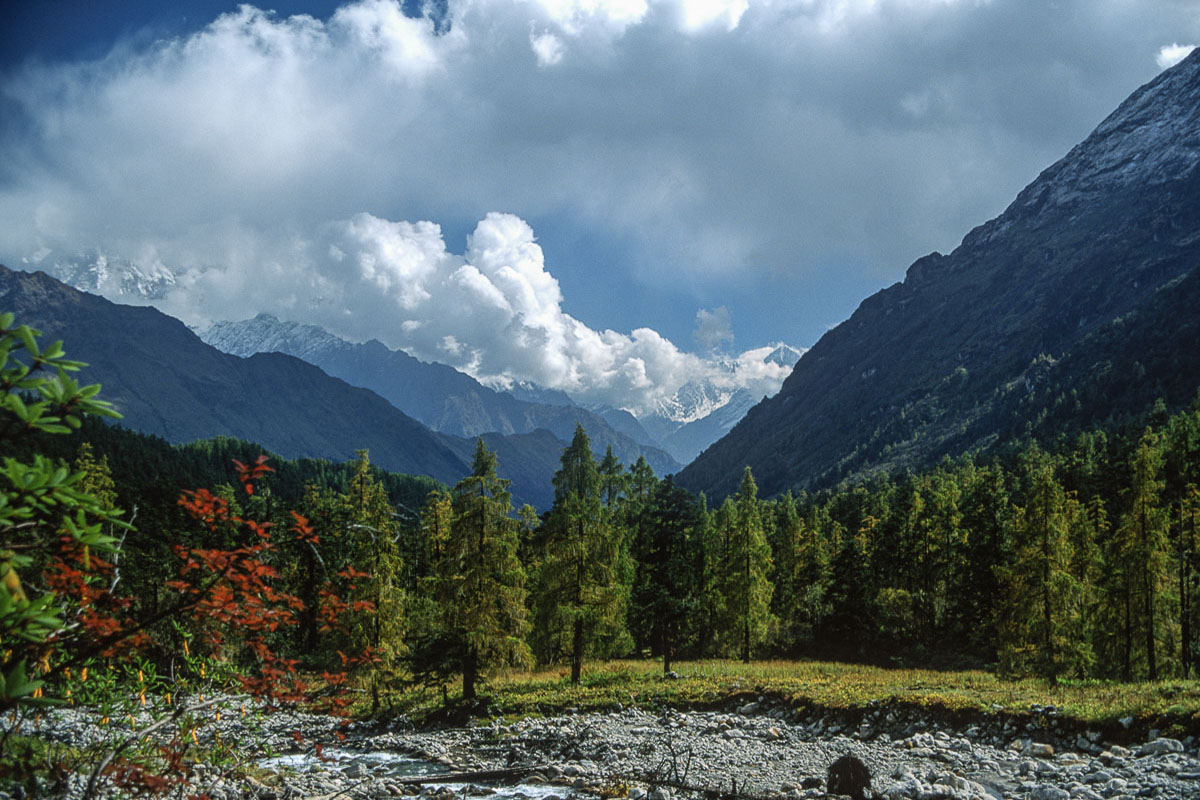
The Upper Chhulung Valley on the Afternoon of our arrival
Next morning the sky was threatening, but the thick cloud and light snowfall offered no obstruction to our upward progress. The path, if there was one, was barely discernible, and the complexities of the route became apparent as we crossed an intervening ridge and traversed a steep snow-covered valley headwall. Then, just as we reached the pass, the full force of the storm set in. The outstanding views of Manaslu and Himal Chuli that I had hoped for were none existent, indeed I could barely see my hand in front of my face.
Beyond the scattering of colourful traditional summit cairns our route disappeared down into the mist and spindrift. The angle of the slope was about 50 degrees and in normal conditions it would have been easy. But the bad weather had deposited a thin layer of soft, powdery snow onto hard ice beneath and my initial attempts to kick steps were futile. Marks in the snow indicated that the porters, who were ahead of us, had tobogganed down on their loads. But I am not one for glissading down slopes without being able to see the bottom and so favoured a more conservative approach.
I had not expected a difficult day and was angry with myself for leaving my crampons in my kitbag. There was no alternative but to begin the laborious and time-consuming task of cutting steps with axes that had been lifted by the Sherpas from the porter loads. We were already cold and hungry, but this was neither the time nor place to hang about. We pressed on, forcing the route down with the bitingly cold wind howling around us, taking four hours to reach the foot of the pass beside the East Chhulung Glacier and the safety of camp.
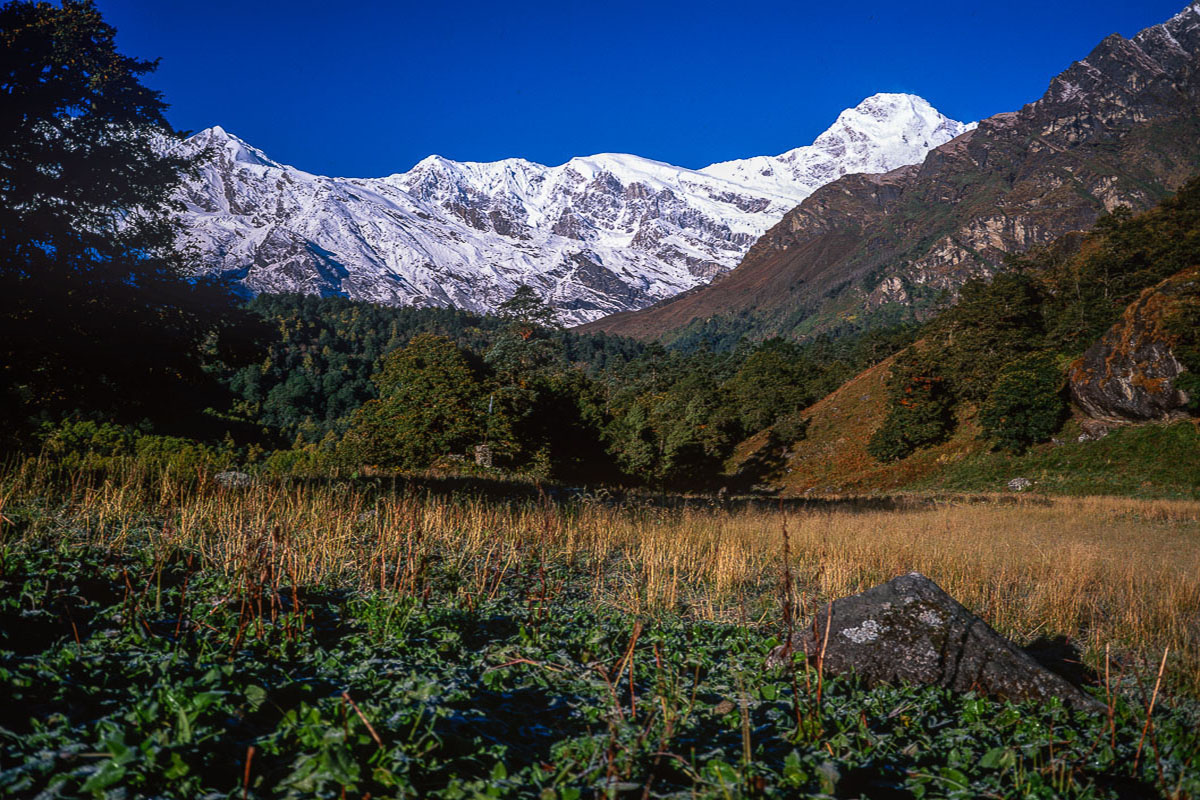
Himal Chuli from the Chhulung Valley
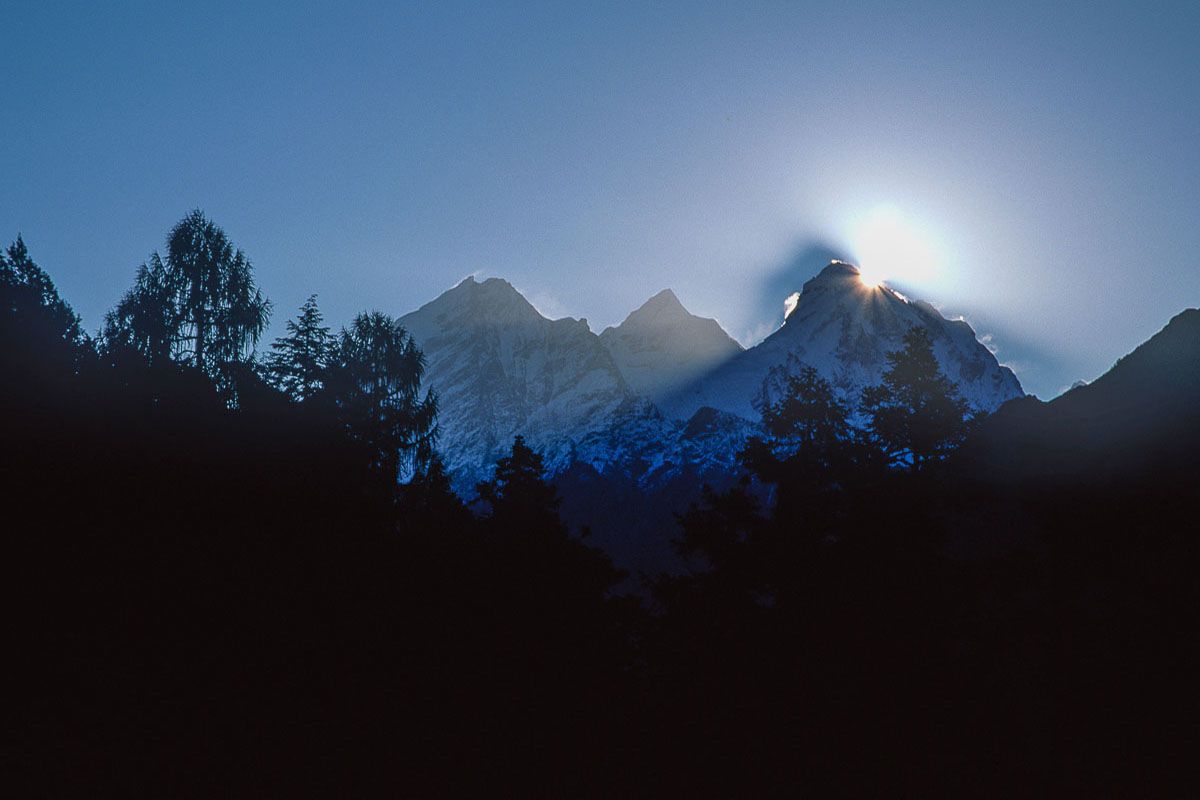
Sunrise on Ganesh Himal from Gomma in the Chhulung Valley
We arrived cold and tired but were soon revived by hot soup, spiced with garlic and ginger, prepared by our Sherpa cook, Chandra. Indeed, his ability to provide sustenance just when it was needed the most was a redeeming feature of an expedition that otherwise was a total gastronomic disaster. The almost daily served fare of tomato soup was inevitably watery and tasteless and the customary expedition cake had both the appearance and consistency of a man-hole cover. The many other concoctions did nothing to awaken our taste buds, but neither did they disturb the other end of our anatomy either. For once, no-one suffered from the infamous Nepalese quickstep!
The storm cleared in the night to leave a beautiful dawn, with a deep blue sky and glistening white summits all around. It was the perfect backdrop for our descent of the Chhulung valley with its tree covered glacier, pine forests and lush Alpine-like pastures. We enjoyed three days of the most perfect trekking, traversing almost vertical grass covered slopes with excellent views in every direction; the peaks of Himal Chuli, Ganesh and Sringi remained constantly in view.
All too soon we turned a corner and there, at last, below us, lay the Buri Gandaki river. The way now passed through the sprawling village of Nyak and down across an almost vertical rock wall to a junction with the main trail coming up the valley. We had accomplished the first of our objectives and celebrated with cokes in the nearest teahouse. It was my round – and typically the drinks cost more than in a four-star hotel in Kathmandu.
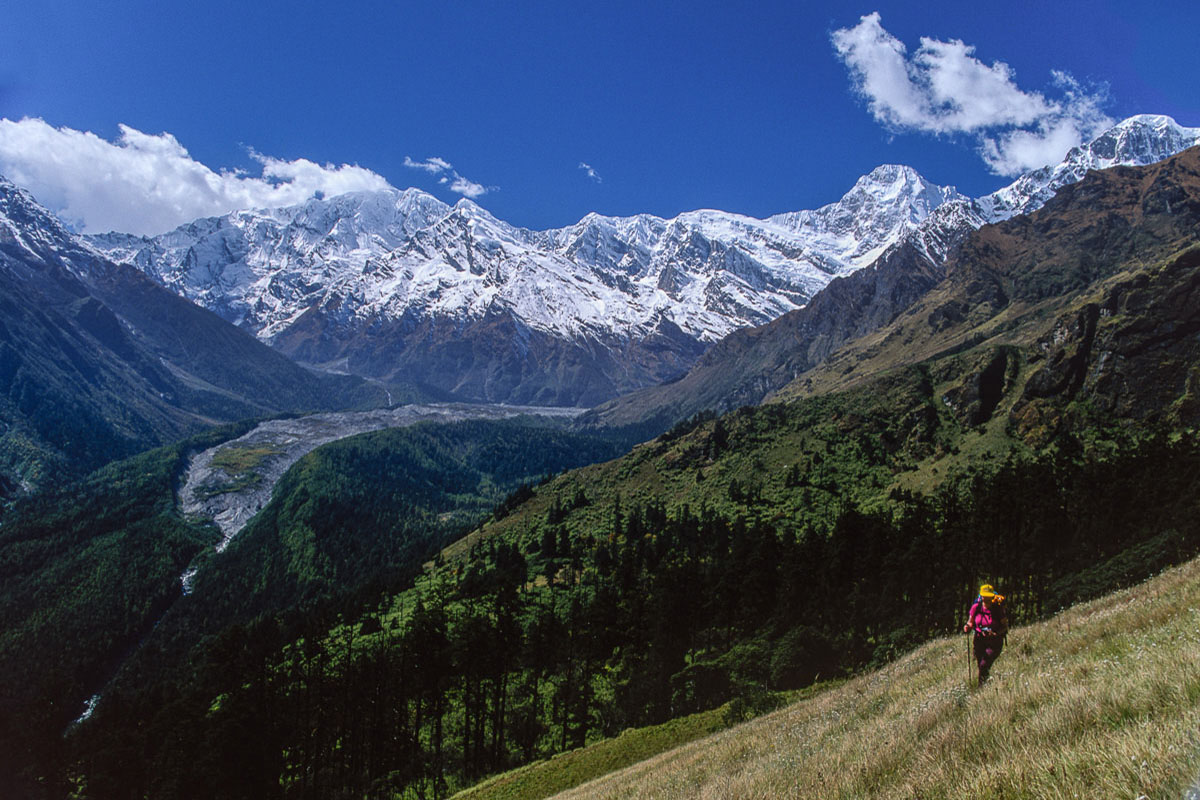
The Chhulung Valley and Glacier : The Rupina La is above the distant valley to the far left
The Buri Gandaki valley is a narrow and steep sided defile and we caught only tantalising glimpses of the high peaks as we passed through the shadowy villages of Deng, Ghap and Namru. The police check-post at Namru marks the entrance to a restricted area and our Liaison Officer, Deorka, completed the necessary entry formalities on our behalf. The aim of the restriction is to police a politically sensitive area and to limit the environmental damage caused by trekking. The regulations place additional costs and burdens on expeditions but regrettably, as our experiences showed, neither objective is being achieved.
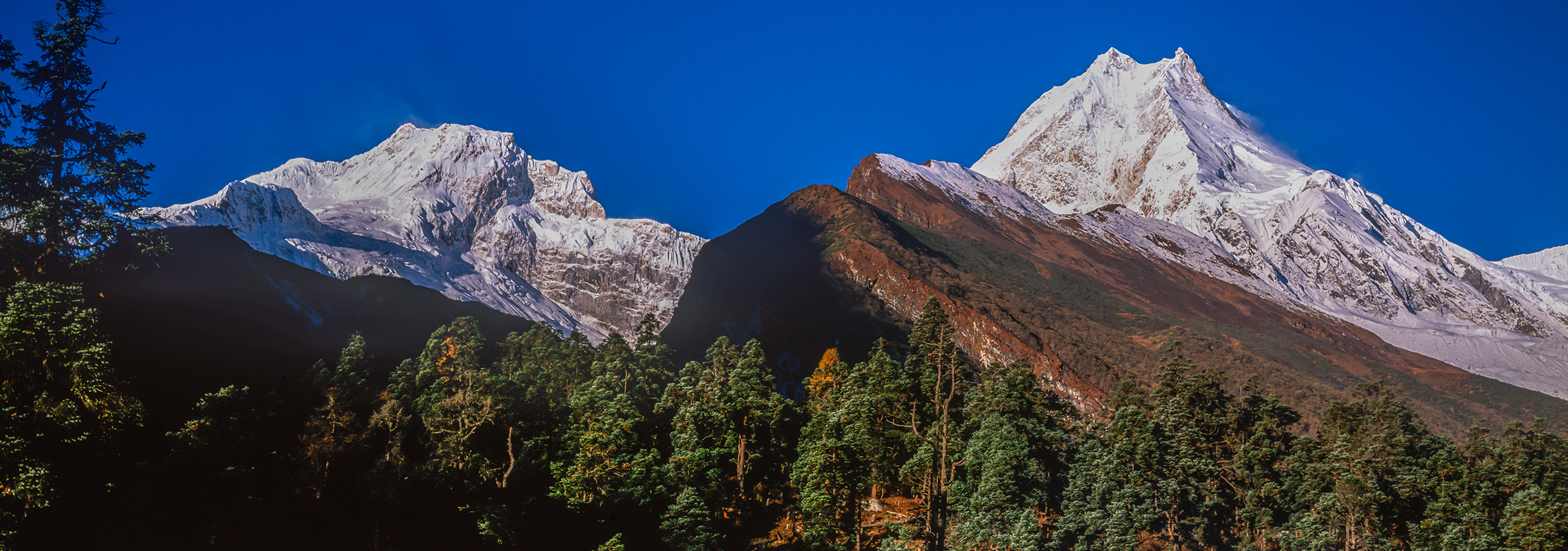
Beyond Namru the valley opened out to reveal the high peaks we had waited so long to see. Ngadi Chuli, or Peak 29 was the first to appear, then Larkya Peak, Manaslu North and finally the huge trapezoid of Manaslu itself. Samagaon is the principal village of the region; inhabited by Tibetans and overlooked by a fine Gompa, it sits in wide open meadows dominated by Manaslu and its main glacier and icefall. Superlatives frequently roll off the tongue when describing the Himalaya, but Manaslu would do justice to the most generous of descriptions; my lasting memory was of a colourful sunrise on the twin buttresses of its east face.
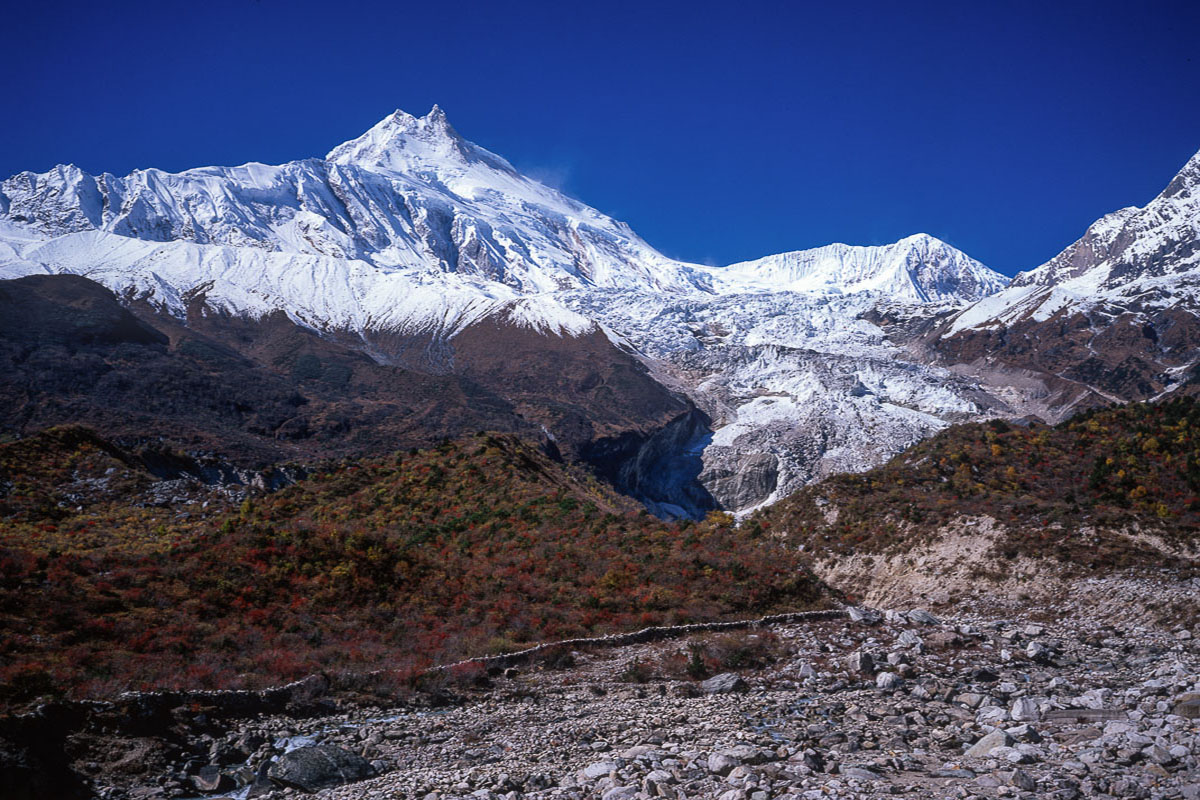
Manaslu, Manaslu North and Glacier from Samagaon
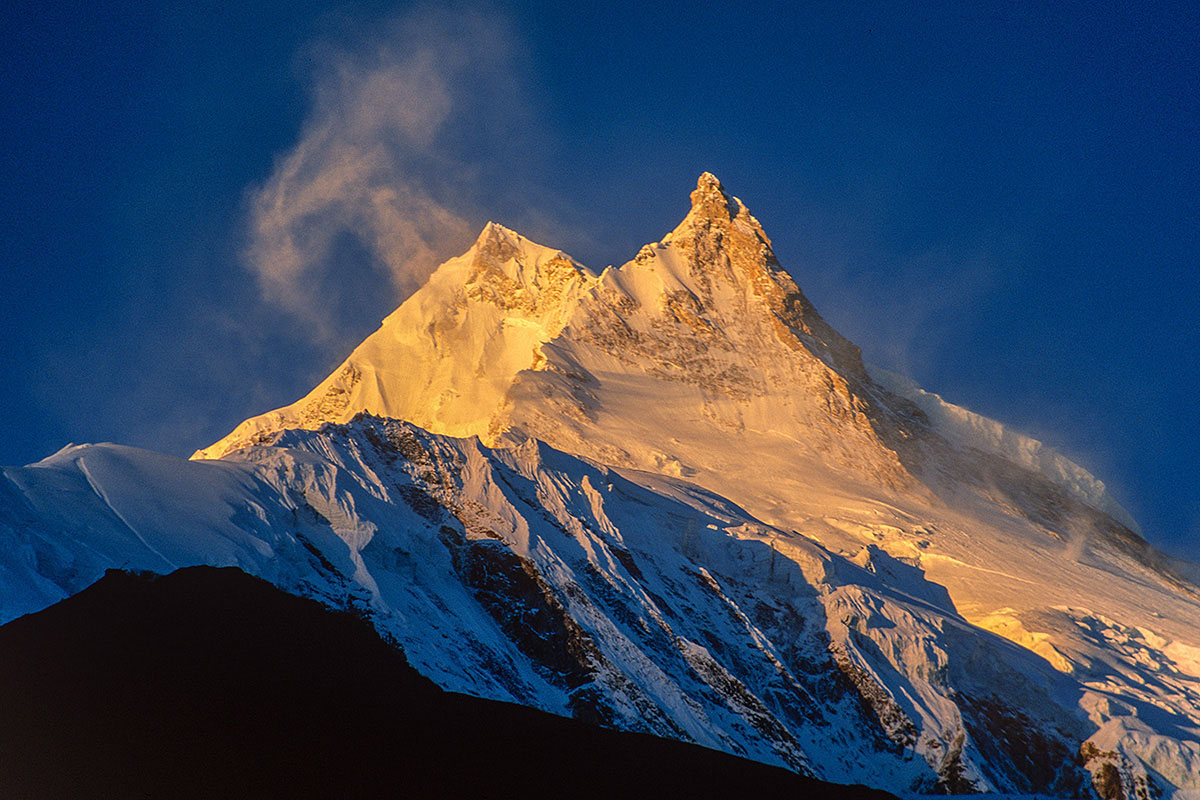
Manaslu Sunrise from Samagaon
We now moved towards the Larkya La pass, through the upper reaches of the Buri Gandaki valley and the remote settlement of Samdo. Tenzing and Deorka were embarrassed by the scene that greeted us at Larkya Base Camp. I was just angry – very angry. The whole area was littered with rusty old cans, batteries, paper, plastic and excrement left by previous expeditions. I wondered how people who professed to love the mountains and who come to this remote area could cause such wanton damage to its fragile environment. We did the best we could to tidy up, and I reminded our already well-disciplined staff of the need to take our rubbish home.
I am an optimist at heart, but that afternoon I couldn’t help but worry about the tell-tale signs I saw in the sky – high winds and spindrift around the major peaks, whispy cirrus clouds turning to blanket alto-cumulous and an obvious rise in the temperature. They all foretold the onset of bad weather.
When I rose at 3 am the next morning all the major peaks had disappeared from view, and as we left camp our torchlights picked out the first few flakes of snow. The way to the Larkya La was very easy and it was just a matter of plodding on, head down, over the steadily rising moraines of the Larkya Glacier. I hadn’t noticed at first, but as dawn broke I realised we had company. We had been joined by over sixty Tibetan refugees, all scantily clad for the conditions, but very determined to reach the pass, and freedom.
Unlike our morning on the Rupina La, there was hardly a breath of wind on the pass. There wasn’t much else either – certainly no views. No Annapurna, no Cheo, no Himlung. Only grey skies, grey rocks and footprints in the snow. The only colour was in the prayer flags that hung, limply from the summit cairn. A little subdued, we still celebrated our achievement, this time with biscuits, Mars bars and cold orange juice. We took a few photographs, and then went on our way.

The trail between Samagaon and Larkya Base Camp
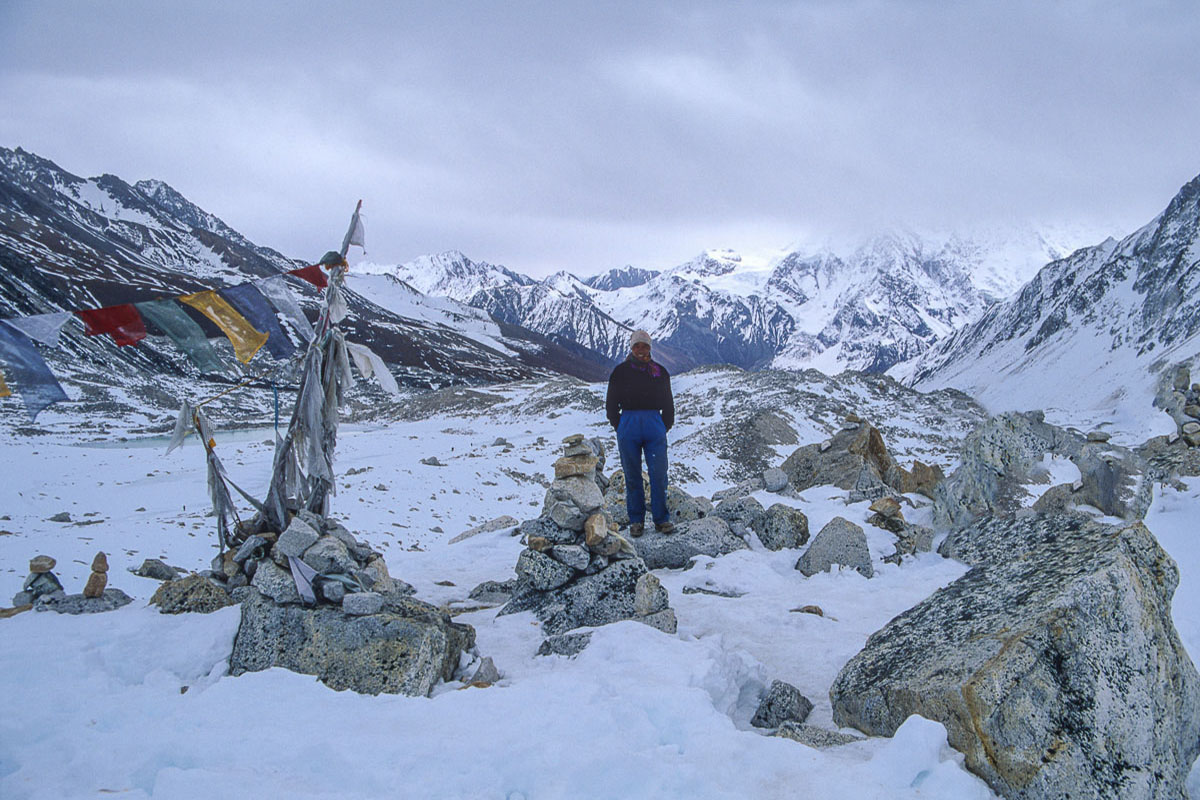
On the cloud and snow covered Larkya La Pass
The descent from the Larkya La passed off without incident, but it was a long way down to Larcia and then the meadows at Bimtang. The atmosphere was dead calm, almost eerie; any snowfall was gentle and light, barely covering the ground. The numerous and complex glacial systems that converged on Bimtang were a frustrating reminder of the proximity of the spectacular mountains that remained hidden above.
Then the snow turned to rain, and the deeper we penetrated the Dudh Khola valley, below the western flanks of Manaslu, the more it rained. Heavy penetrating rain that seeps everywhere – into boots, into jacket pockets, into rucksacks, into kitbags, into tents – soaking everything in a manner that reminded me of a cold, damp and dark November day in the Scottish Highlands. It tried the patience of even the most experienced of us as it fell upon us constantly for four days, all the way to Dharapani, where the Dudh Khola meets the Marsyangdi valley and the motorway that is the Annapurna trail. To our great relief the sun finally re-appeared at Dharapani, and we spent the warm and pleasant afternoon drying all our clothing and gear.
The final few busy days’ walking to the roadhead at Besi Sahar came as a shock to the system after the peace and quiet of the Chhulung Valley and the Larkya La. We heard news that a major storm had affected all of Nepal and had deposited over two metres of snow higher up. All the high passes were blocked. We had been the last people to cross the Larkya La.
But our problems continued. The road to from Pokhara to Besi Sahar was a mudbath and our bus could not reach us. We hired a lorry instead. Room was limited up front, so as leader of the trip I volunteered to sit in the back with the porters and the gear.
As I bounced around for the next two hours, I thought how things might have been, recalling those marvellous views and wonderful journeys that I had experienced and enjoyed for so many years. This time we had been subjected to a fortnight of bad weather, snow on both passes and now, to cap it all, an unceremonious end to the trip in the back of this lorry. In my own mind I thought “That’s it, I’ve had enough, I’m not coming to Nepal again; never, ever again!!” .
Then suddenly we turned a corner and from my vantage point beneath several kitbags I caught a last glimpse of the whole Manaslu massif, its tall snow covered summits gleaming and beckoning in the early morning sun. “Oh well”, I said, “perhaps just one more trip, but not just yet!!” (see note below)
Note : Ian would return to the Himalayas four years later on the first of six more trekking expeditions of which he led four to the Everest region, two to Sikkim and one to Bhutan before finally retiring from Himalayan expedition leadership in 2016.