

The Himalayan Adventures
Mera Peak
By the Tilman Approach
STANDING IN SPLENDID ISOLATION above the remote and beautiful Hongu and Hinku valleys in north-eastern Nepal, the summit of Mera Peak, 6654m, 21,831 ft, is regarded by many as one of the finest viewpoints in the Himalaya. Listed by the Nepalese authorities as one of the peaks open to attempts by small recreational groups of climbers, and despite being the highest of such peaks available in the Khumbu region, the normal route to the summit via the north ridge is without major technical difficulty. Over the years Mera Peak has therefore become a very attractive and popular objective for groups of competent mountaineers who may not necessarily be expert climbers.
More often than not, the mountain is now approached from the west along the Hinku valley which in turn is accessible from Lukla airstrip via the 14,000 ft. Zatrwala pass. An alternative is the easier 10,400 ft. Pangkongma La, which can be reached in only a few days from Lukla or in a week from the road head at Jiri.
However, in the autumn of 1988 when the area was rarely visited, I organised and led an expedition of six climbers content to climb Mera Peak by its north ridge, but intent on exploring a different approach from the south east. Our chosen route followed that pioneered by Bill Tilman in 1950, and it was interesting to note that the much of the useful information I found on it was contained in his book 'Nepal Himalaya'. Several advantages ensued from this approach; we encountered a variety of scenery and cultures, did not have to retrace our steps on any part of the journey in or out of base camp, and the trails were relatively quiet and unspoilt.
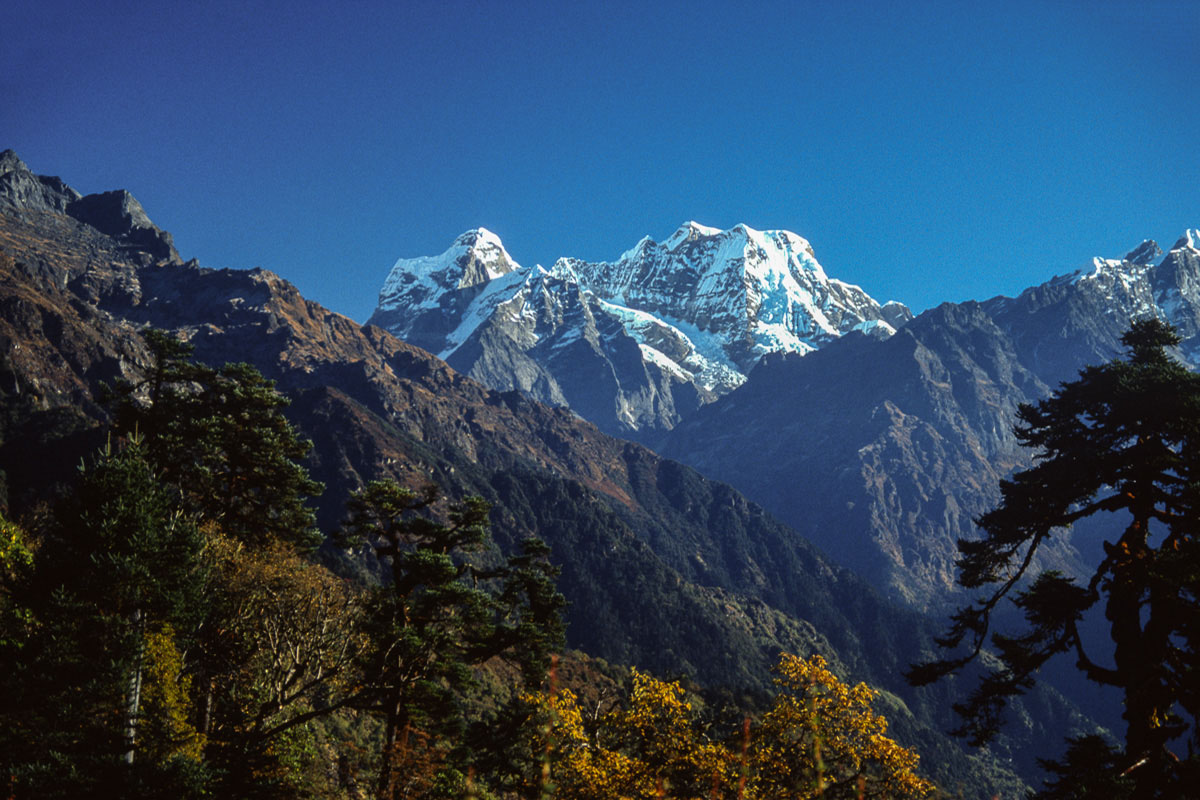
Mera Peak from below the Zatrwala Pass
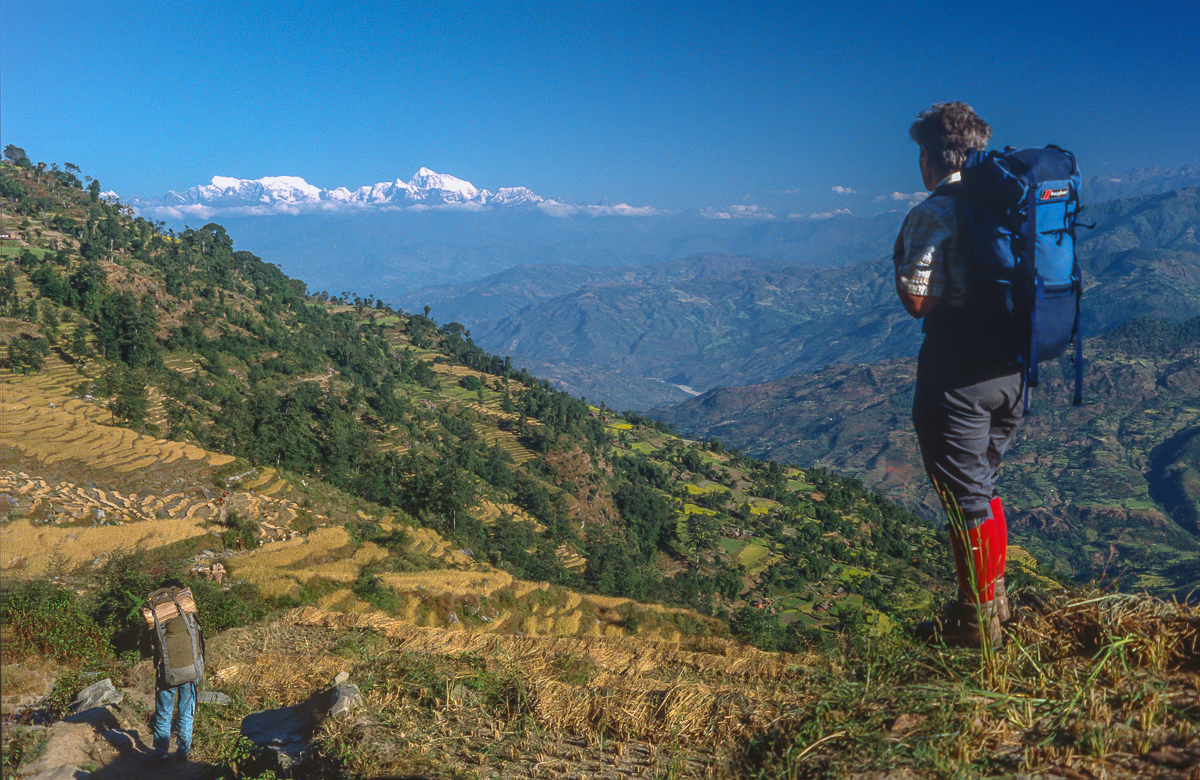
Makalu and Chamlang from near Hille
Our journey from Kathmandu began aboard the morning flight to Biratnagar and then continued into the mountains on a finely engineered road through the towns of Dharan and Dhankuta. After a very bumpy and dusty journey which took us from sea level to over 6,000 ft, we finally arrived in the small village of Hille at dusk. The following morning we made a lengthy descent into the Arun Valley, but not before we were blessed with magnificent views of Makalu and Chamlang to the north.
For three days we then walked along the east bank of the Arun river. Most of the time the path was broad and obvious, though occasionally we found ourselves delicately negotiating our way through paddy fields or trudging across soft sandy beaches. The local people, mainly Rais, Limbus and Chetris were very friendly and showed as much interest in us as we did in them; they curiously examined our cameras, sleeping bags and other western paraphernalia.
However, the heat and humidity were almost unbearable; expedition members frequently sought shelter under trees or in the local villages. We welcomed the cooling rains of afternoon thunderstorms, unaware that they were also depositing fresh snow on the higher passes. The bridge across the Arun was misplaced on our map by over three miles, but we finally located and crossed it near its junction with the tributary of the Irkhua Khola.
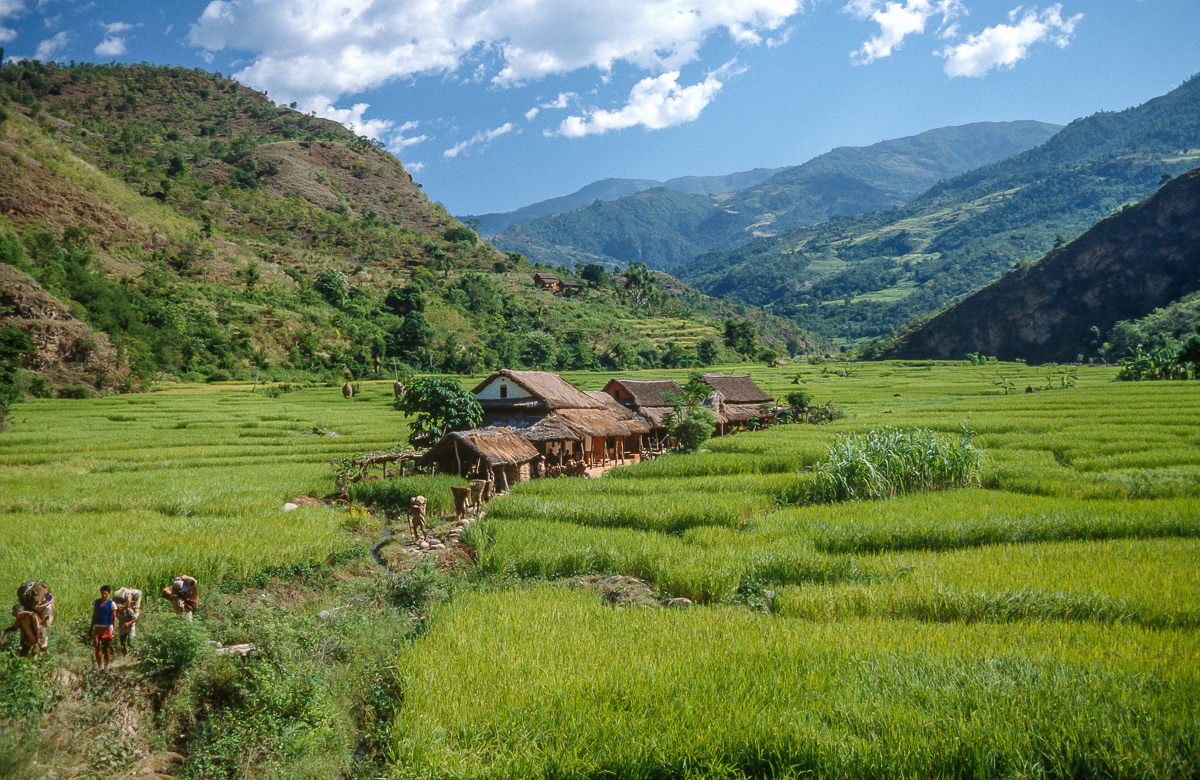
Paddy Fields in the Arun Valley
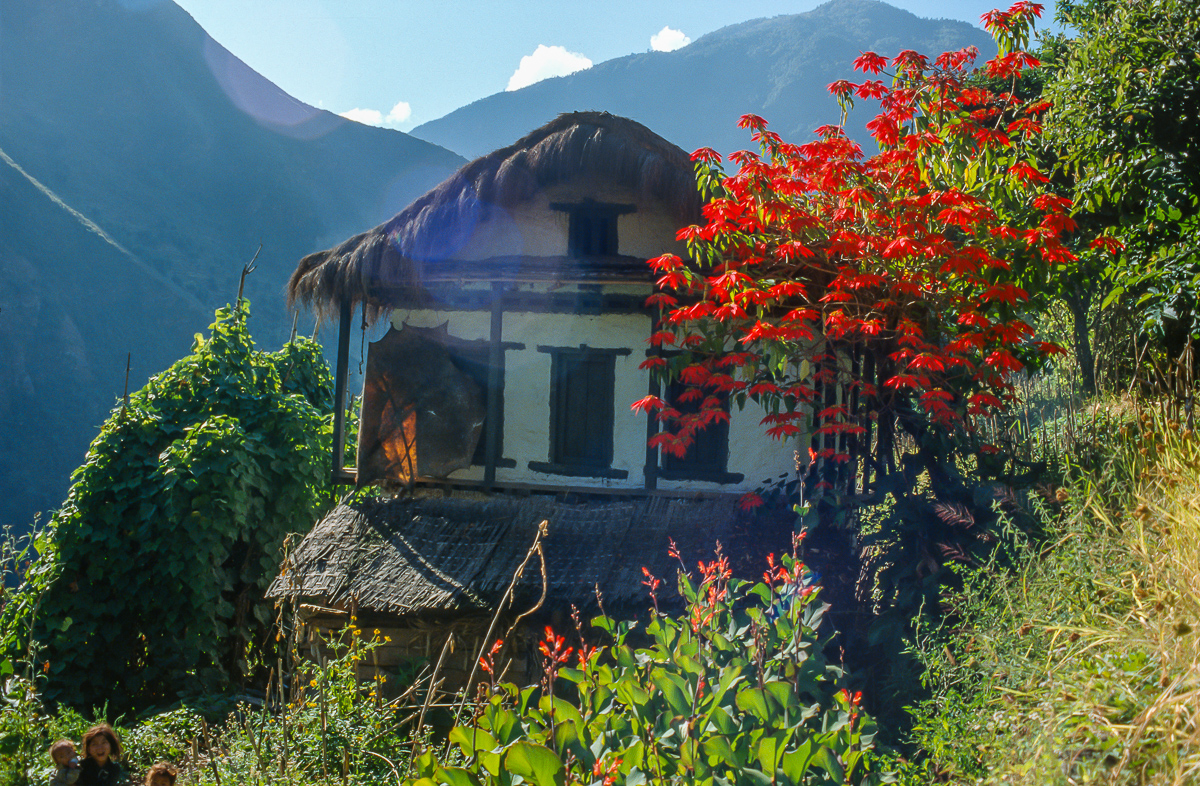
Local House in the Hongu Valley
The character of the route changed as we left the Arun valley and began the long ascent towards the Salpa Pass, crossing and re-crossing the Irkhua Khola by a series of bamboo bridges which were more picturesque than substantial. We passed through several tiny villages, tenuously linked by a path which often disappeared into the undergrowth. It was impossible to identify the pass from below as each successive turn and rise in the valley revealed yet higher and more complex enclosing ridges. The steepest rise was just above the village of Phedi, and our efforts were rewarded with marvellous views of the valleys below from sun drenched breaks in the forest.
We experienced our first sub-zero night-time temperatures at a camp in a small clearing just below the pass, and there was snow lying beside the large chorten on the pass itself at 11,400 ft. Our pleasure at crossing this key watershed made up for the disappointing views; we had hoped to get a comprehensive view of our objective, but the only peaks visible were Karyolung, 21,362 ft, and Numbur, 22,832 ft, on the west side of the main Dudh Kosi river. Below, the path descended into thick moss hung forest towards the village of Sonam and the main Hongu valley.
The villages of Gudel and Bung are located at almost equal elevations on opposite sides of the Hongu valley and the horizontal distance between them is less than two miles. However, the sight of the great cleft which divides them brings tears to a walker's eyes as he begins the frustrating and seemingly pointless vertical diversion of some 2,500 ft. There is some consolation in the striking view from the campsite perched at the top of Gudel; the whole valley stretches beneath one's feet and is crowned by a gleaming wall of ice that supports Chamlang's 24,013 ft summit. To our surprise and disappointment, Mera still remained hidden behind its many outliers.
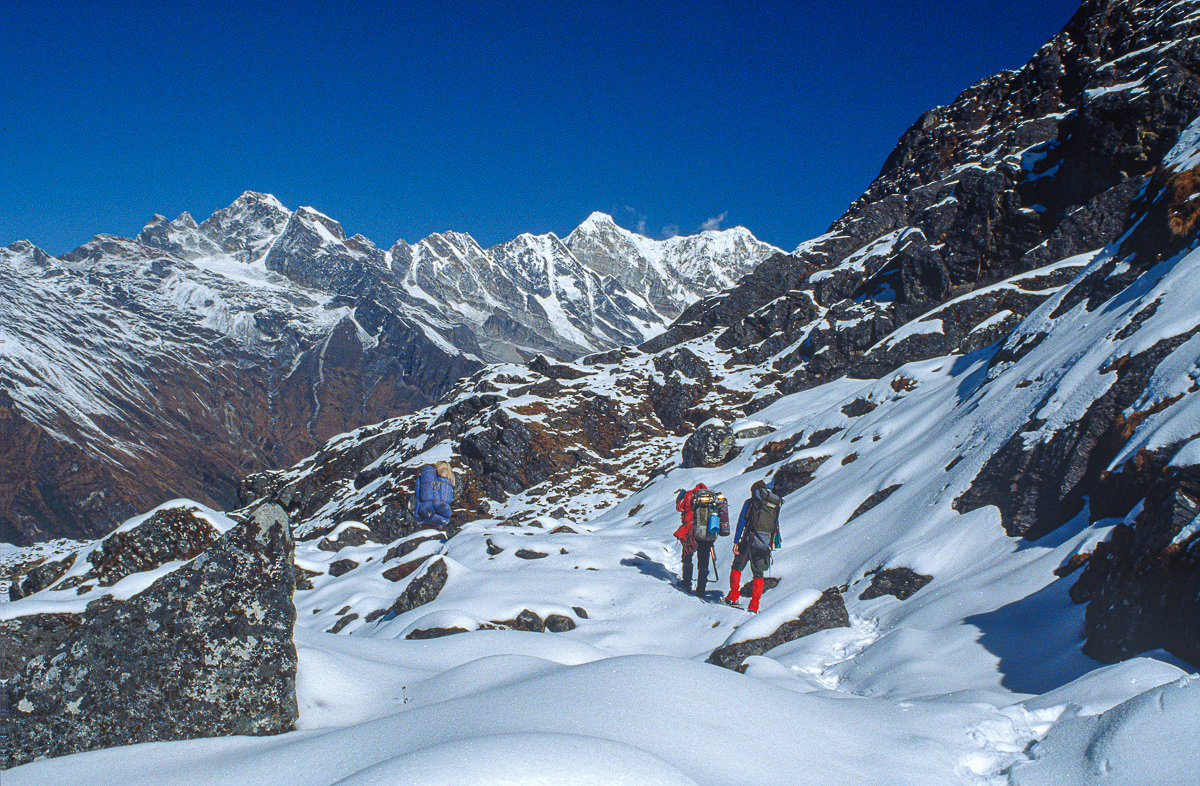
Descending into the Hinku Valley from Panch Pokhri
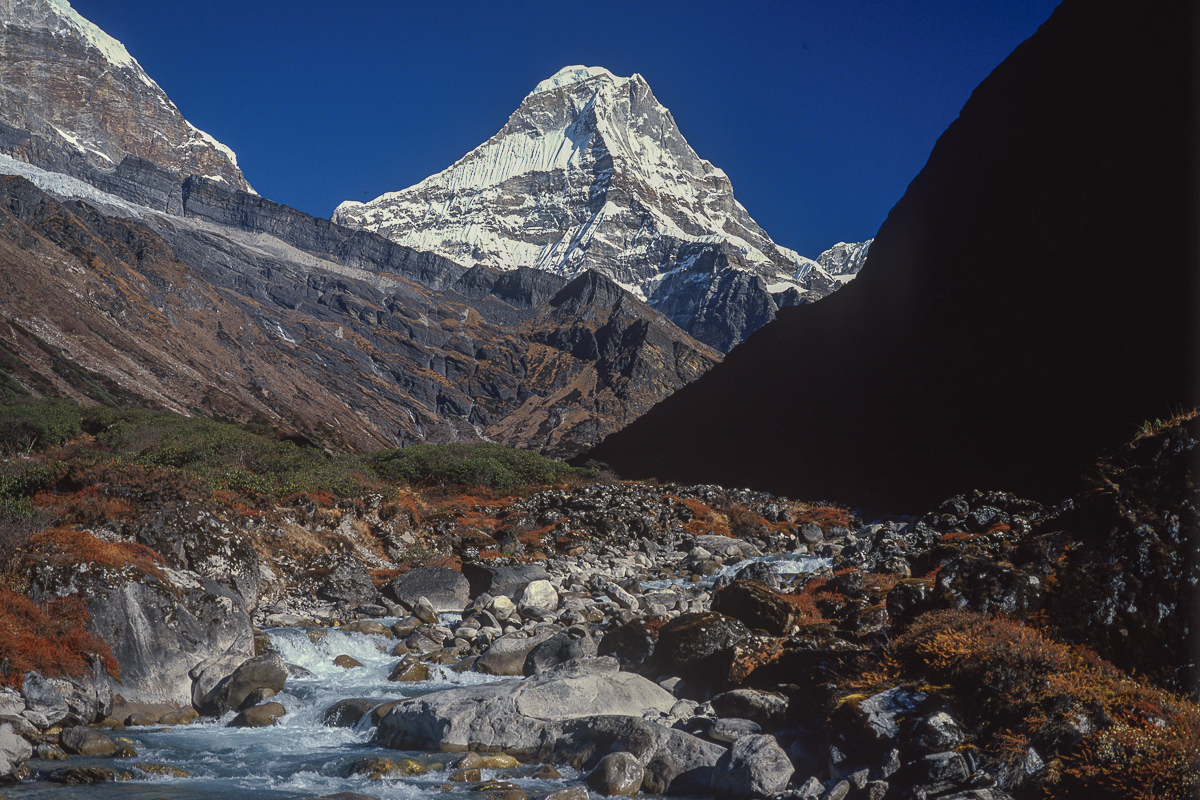
Tagnagtse from The Hinku Khola
During our descent to the new suspension bridge over the Hongu Drankha we could see the problems confronting any expedition approaching the upper Hongu basin from the south. The steep sides of the main valley are cut by many deep side valleys, and dense forests will make route finding extremely difficult. Fortunately we did not encounter this problem; the terrain above Bung was open, cultivated and, accompanied by the occasional mani wall, it was so typical of the Khumbu.
The main trail to Lukla crosses the Sukie La pass, but we left this in favour of a way along the Sukie Danda, a long ridge thickly covered in rhododendron and bamboo forest extending southward from Mera and separating the Hongu valley from its westerly neighbour the Hinku. Deep soft snow made the going much harder than we had anticipated. After two days' walking and several diversions over spurs on the west side of the main ridge, we were able to see down into the Hinku valley from beside an idyllic cluster of small lakes known as the Panch Pokhri at a height of 14,000 ft.. The snow continued to be a problem on the long steep descent to the Hinku Drangka, so we were a tired group when we arrived at a clearing in the forest which was the campsite of Mosum Kharka.
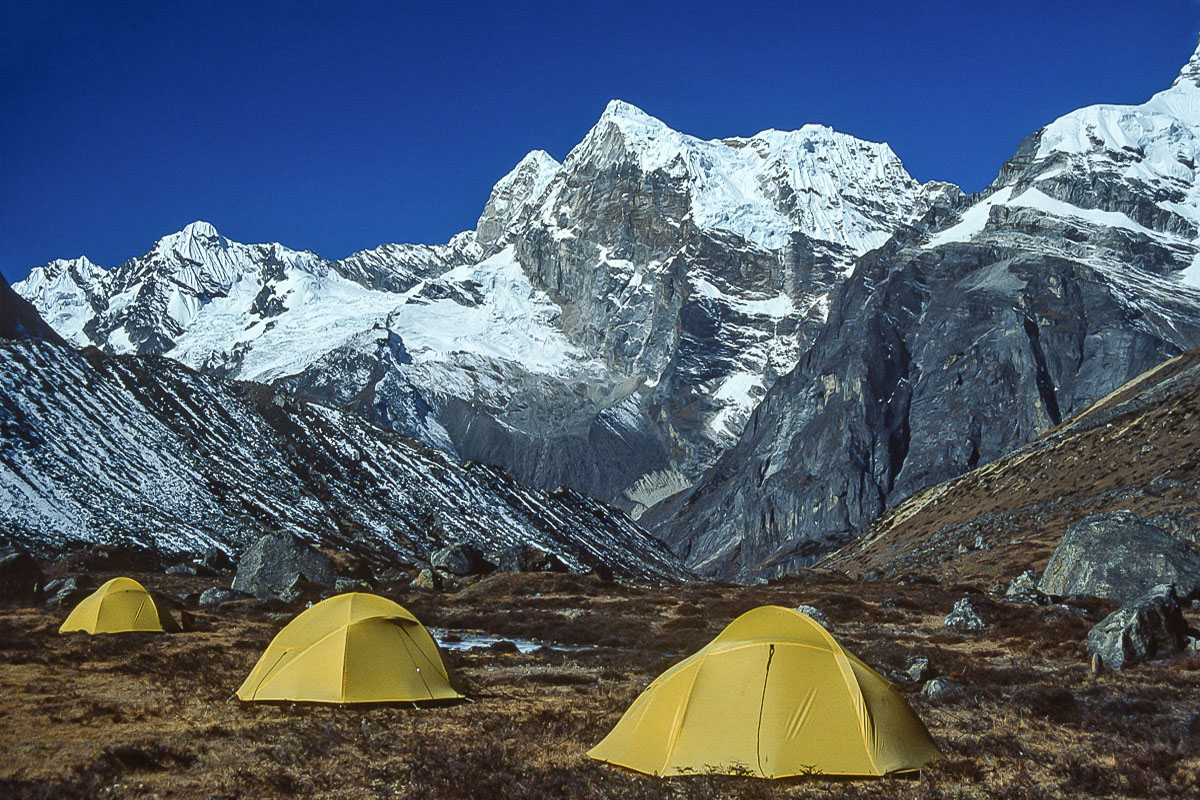
Kossum Kangurru from Dig Kharka

The Mera La from Dig Kharka
The Hinku is one of the most beautiful and unspoilt valleys of Nepal and is soon to be protected by its inclusion within the extended boundaries of the Sagarmatha National Park. In its lower reaches the valley sides are steep and covered in dense fir and rhododendron forest. Above Mosum Kharka the valley widens and the blue-green river tumbles gently down against a backdrop of elegant peaks which include Gongla, 19,072 ft, Kossum Kangurru, 20,896 ft and Tagnagtse (also known as Peak 43), 22,209 ft. The trails on both sides of the river give easy and enjoyable walking; they are linked by a tiny bridge just two miles south of Tagnag which, at 14,300 ft and with its walled grassy fields, was an ideal location for base camp.
As we walked into base camp we were relieved to detect an improvement in the weather; the stable blue skies of mid November had finally arrived and we dared to entertain thoughts of a clear summit day. Three miles to the west we could see the level glacier of the Mera La and the short tongue of ice that provided access to it.
We explored the glaciers surrounding our camp, using the time to acclimatise and to plan our ascent of the mountain. We moved our camp upward just a further 1,000 feet to another delightful meadow at Dig Kharka from where we spent the afternoon photographing the surrounding peaks of Gongla, Tagnagtse and Kossum Kangurru whose twin summits rose high into the clear blue sky. The route beyond to our 'advanced' base camp of Khare at 16,000 ft. skirted the moraines of several glaciers and gave us spectacular views of Tagnagtse.
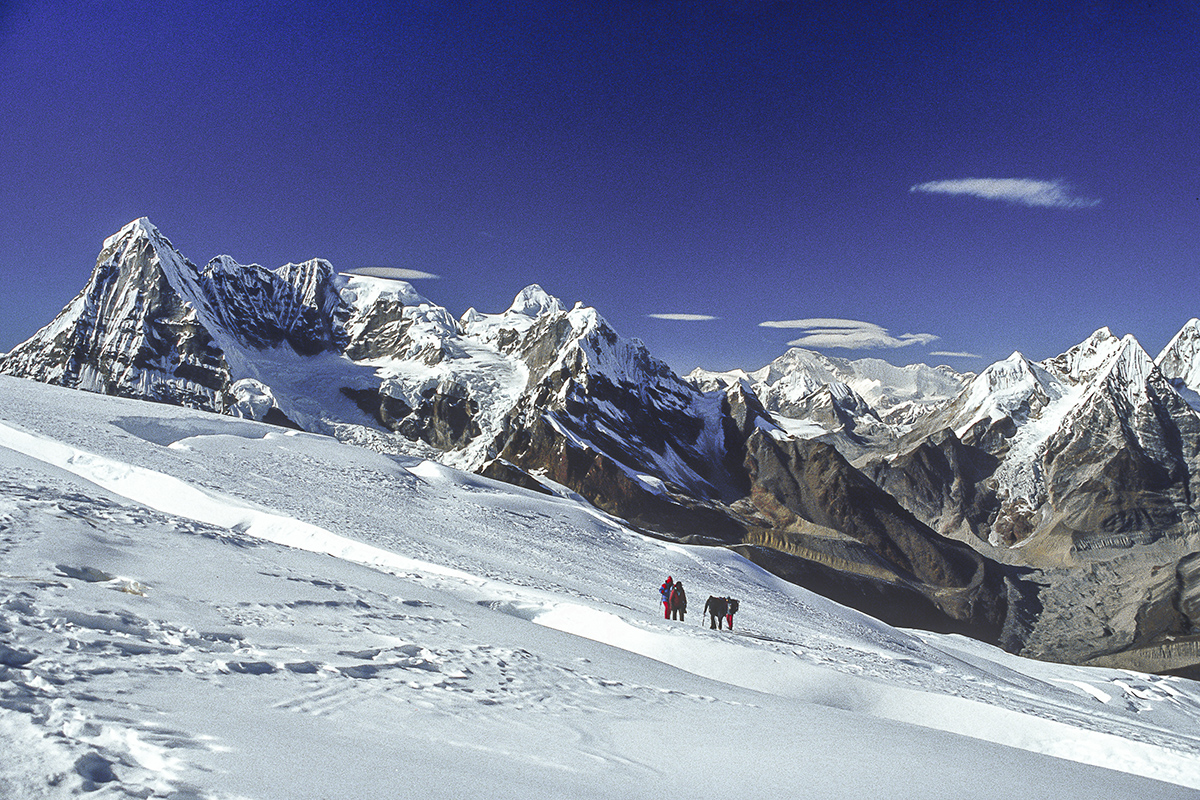
Ascending the Mera Glacier - Cho Oyu in the far distance
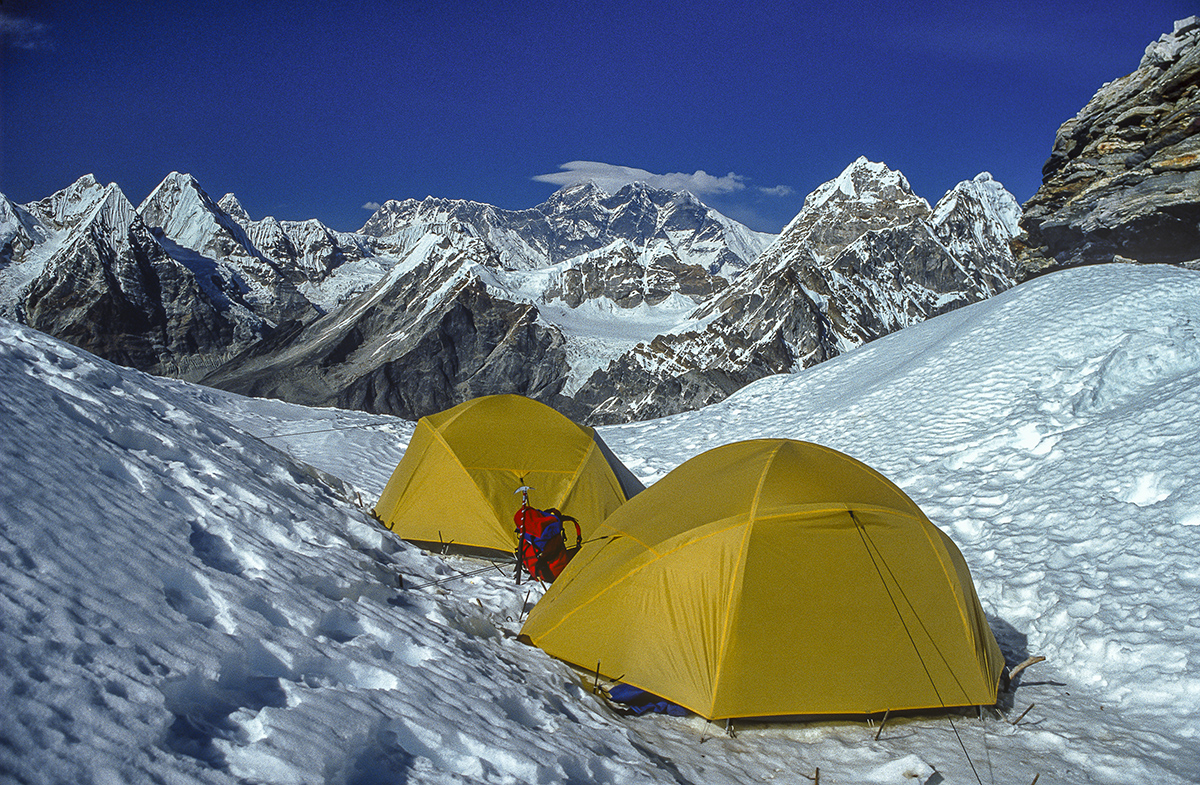
High Camp - Everest in the distance
We left Khare early the following morning. Above the slippery screes that formed the snout of the Mera glacier, a tiny track led upward between the side of the glacier and its retaining wall; after a short but moderate scramble we were soon able to gain safe access onto the ice. It was a joy finally to set foot on the mountain and after a further hour we had negotiated the three ascending tiers of ice and traversed the level glacier to the 17,766 ft col of the Mera La.
From this point on, the climb would be similar to many in the Alps, but the location and character of the mountain made it much more demanding and committing. Succumbing to altitude sickness was a risk of which we were all well aware, but our lengthy approach from Hille and careful acclimatisation programme was planned with that in mind. We we more concerned by the likelihood of being caught out in bad weather on the vast, exposed and highly crevassed Mera Glacier. However, the weather remained cold but settled and we made good progress up and across the lower slopes of the mountain.
Each climber was accompanied by a Sherpa. My companion was Ang Nima, a good friend with whom I had climbed several times before. Together we soon found the route across the crevassed glacier and from there the way was clearly visible across ever steepening snow and ice slopes towards the summit. We established a high camp beside a rocky outcrop at 19,500 ft amidst the vast sterile wastes of the glacier.
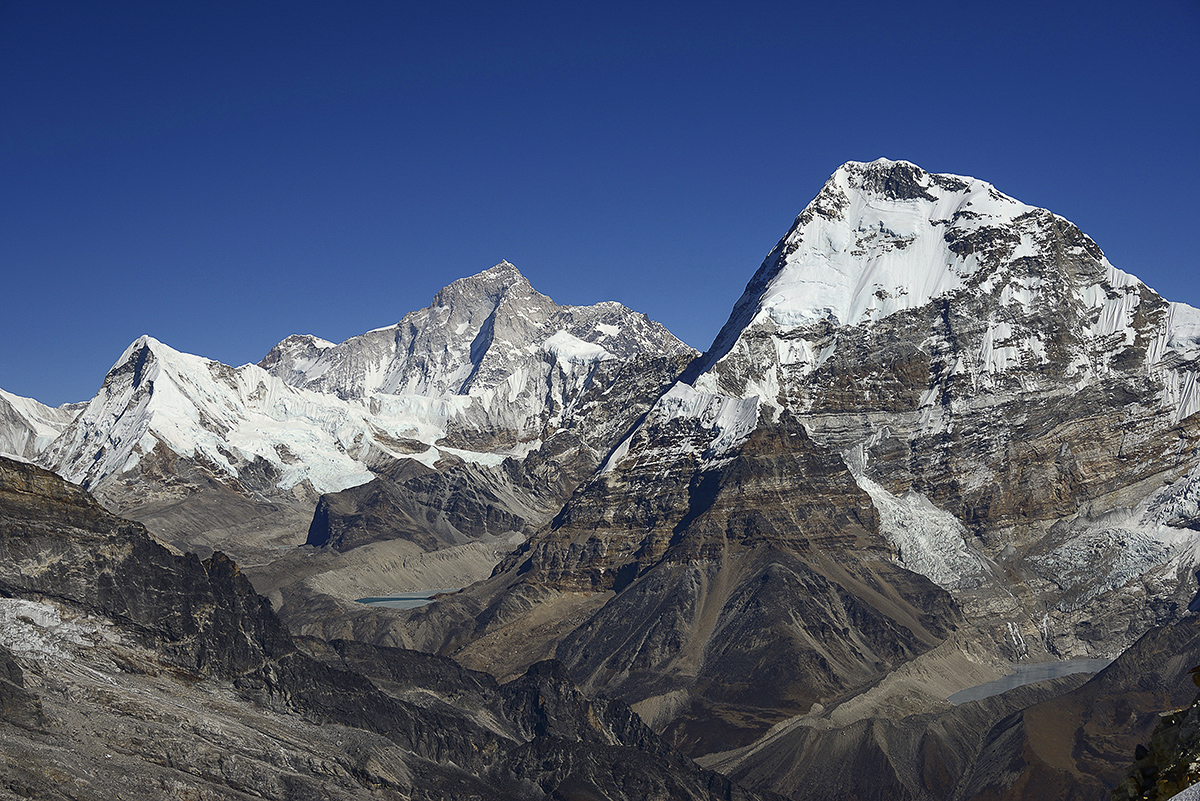
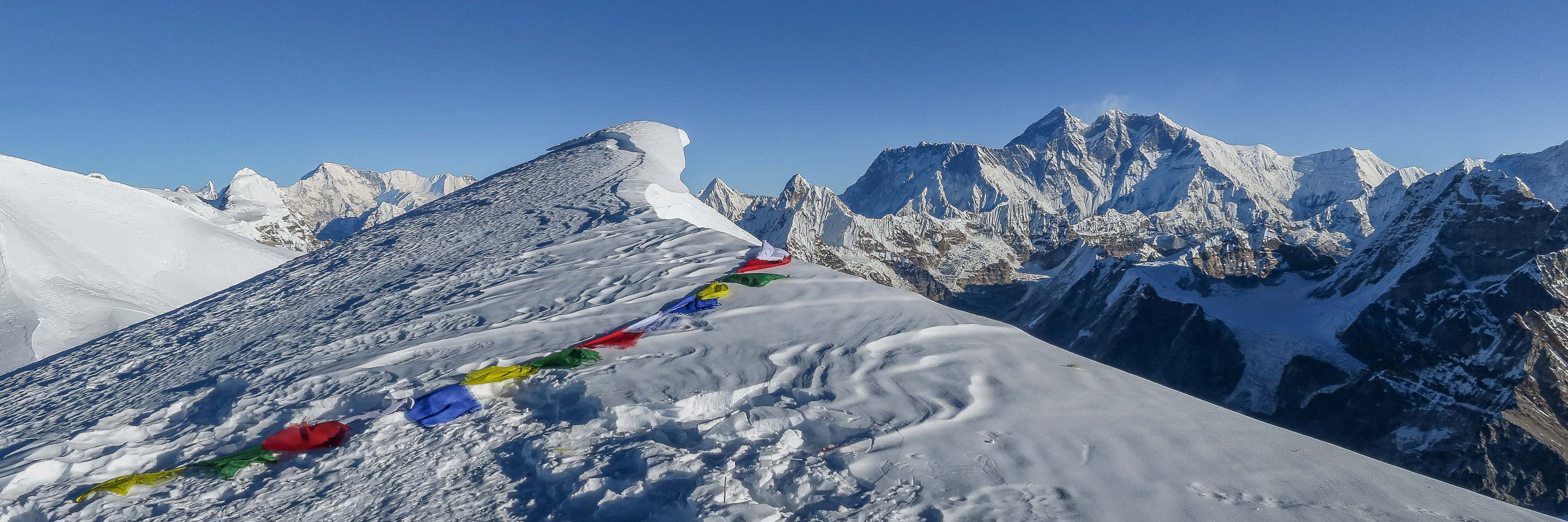
Makalu and Chamlang from Mera Peak
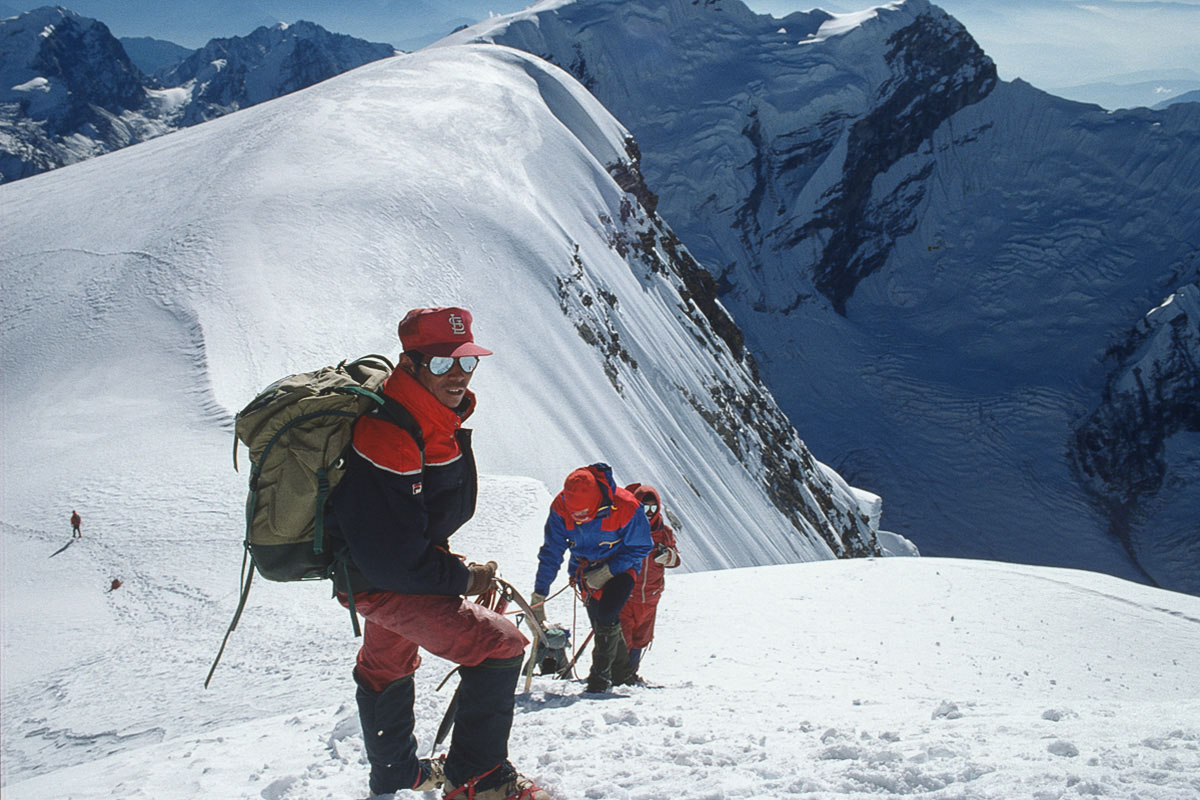
The Final Steps to the Summit of Mera Peak
I leaned out of the tent door to watch the sunset unfold its colourful spectacle on Everest and then retired to the warmth of my sleeping bag. It turned out to be a bitterly cold night. We began our summit bid at 3am the next day. The silence of the still, cold pre-dawn was punctuated only by the sound of crampons biting into the ice and of climbers gasping for breath. A spectacular sunrise was accompanied by a strong and bitterly cold wind, but our consolation was an incredible panorama of surrounding peaks. It took three hours to reach the summit ridge. The final obstacle was a fifty foot tower of snow and ice - hardly difficult back home - but rather awkward under these conditions. Ang Nima belayed me as I kicked those final steps and we then walked together to the summit itself.
The sky was cloudless and the view extensive. Everest, Kangchenjunga, Makalu, Lhotse and Cho Oyu dominated a panorama which extended in all directions; massif after massif of snow capped mountains stretched out to one horizon, a mosaic of lowland ridges and valleys to another.
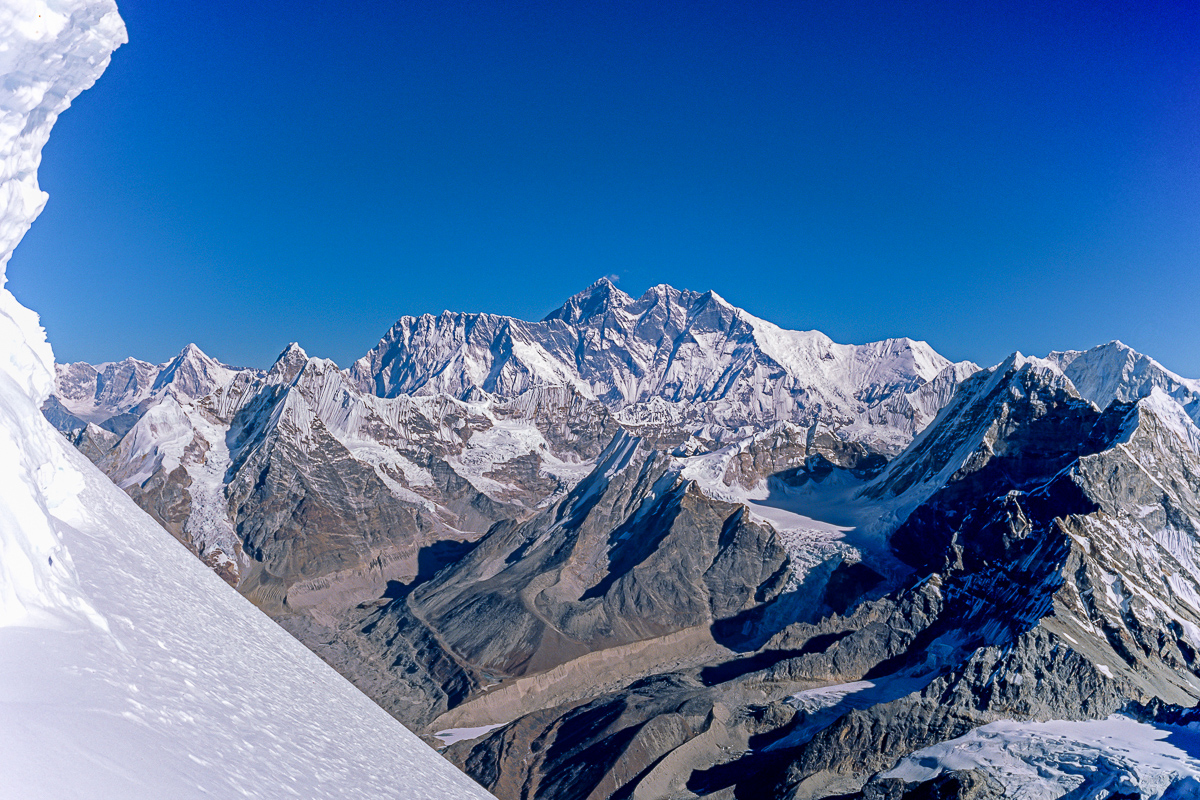
Everest from the summit of Mera Peak
Our summit success was achieved by a few but shared by all. The greatest achievement of our expedition was the companionship that had developed between members, Sherpas and porters. We were all very sad when we paid off the porters and said goodbye to our Sherpa friends; our obvious affection for them was reciprocated in their traditional parting gift of silk scarves. We had been together as a team for over a month and had shared so many happy as well as difficult moments; old friendships had been strengthened and new ones forged.
Our friendly expedition enforced a belief that I hold about mountaineering. The objective in itself is not important; the value of any expedition is in the manner by which it achieves its objective and in the quality of the experience that members gain from it.