

The Himalayan Adventures
Baltoro
Icy Highway to K2
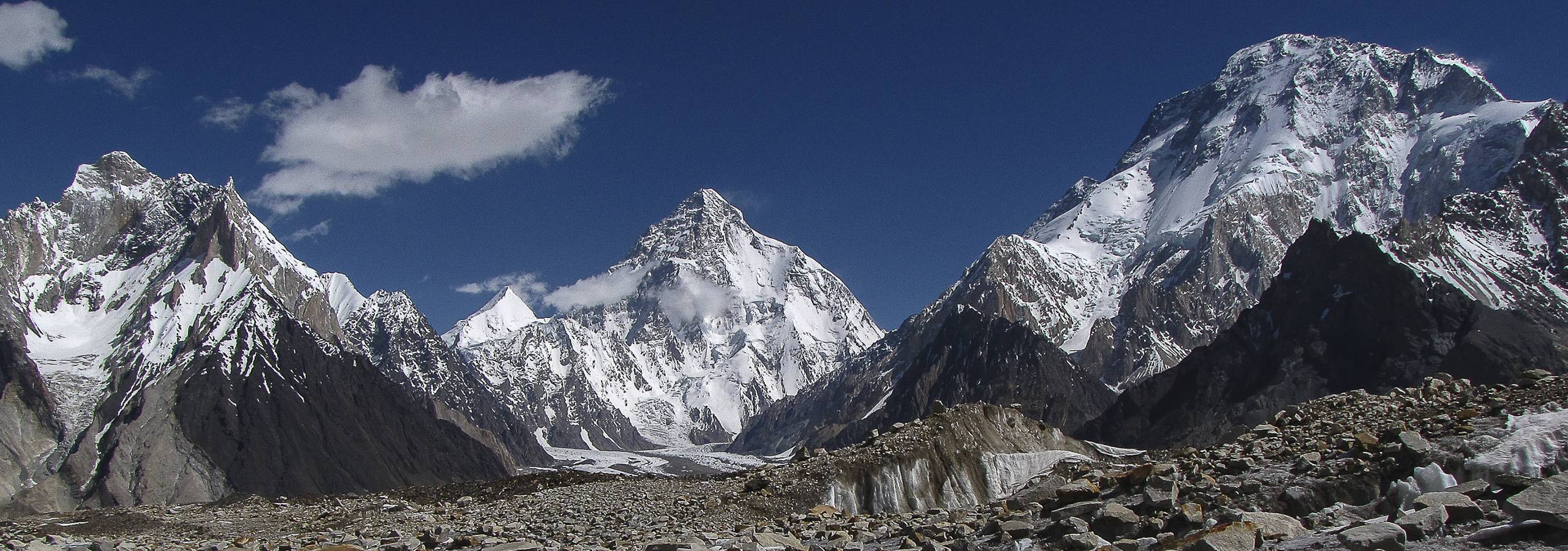
THE 'ROOF OF THE WORLD' is popularly defined as that region which lies along the Nepalese-Tibetan border and contains the highest summits of the Greater Himalaya. However, well-informed mountaineers and geographers will justly argue that it is the Karakoram, a sub-range of the Himalaya in northern Pakistan, which contains the world's greatest concentration of really high and spectacular mountains. Particularly impressive are the peaks overlooking the Baltoro Glacier, of which four exceed 8000 metres and include K2, at 8611 m or 28,250ft, the world's second highest mountain. The sheer scale and magnificence of these mountains, combined with their breathtaking and awesome beauty has inspired mountaineers to refer to the area as 'The Throne Room of the Mountain Gods'.
Despite this wealth of magnificent scenery and in total contrast with the Everest region of Nepal, the Karakoram attracts considerably fewer trekking groups. This was once attributable to stories of porter strikes, access problems and continuously bad weather which were reported by many of the early climbing expeditions. However, more recently is it more likely to be Pakistan's failure to develop the trekking potential of the Karakoram since it re-opened in 1974, and the shortage of maps and detailed information on the routes which lead to the very heart of these great mountains.
This article describes the classic trek through the Braldu Gorge and along the Baltoro Glacier to Concordia, the great glacial amphitheatre in the shadow of the very highest Karakoram peaks. It serves as a general guide to the Braldu-Baltoro region but is principally designed to inform the experienced trekker considering this journey of the difficulties and rewards that will be experienced on route.
The Karakoram is an area of considerable natural instability and the routes described are likely to change from year to year. River levels rise and fall significantly throughout the year and affect the location and availability of crossing places. The recognised trekking season extends from May to October but extremes of temperature as well as significant and prolonged precipitation may be experienced at any time.

Skardu Rock, Indus Valley, Pakistan
The assembly point for expeditions entering the central Karakoram is Skardu, a startling green oasis set amidst sterile sun-baked pinnacles rising high above the Indus River. It is reached either by a twenty-four hour drive along the Karakorum Highway, or a one-hour flight from Rawalapindi. I have used both options. In common with Nepalese mountain flights the schedule is dependent upon the weather and Lukla-style delays are frequent. The flight is a great time-saver but the drive is something worth experiencing at least once in one's lifetime !
Situated at 2300m, Skardu is an excellent place to acclimatise to the altitude and scorching heat that will be encountered in the lower Braldu valley. There is plenty to do here if time permits; exploring the bazaar, visiting the Satpura Lake, climbing the Rock of Skardu or just watching one of the many local polo matches.
The initial fifty miles of the route beyond Skardu follows the course of the Shigar river to the village of Dasso. It is usually accomplished in an open jeep along a newly built track and the drive is inevitably hot, dusty and bumpy. The scenery is quite spectacular and adequate compensation for this discomfort; the rich greens of the cultivated areas contrasting dramatically with the ochre and brown rock of the adjacent and wastelands.
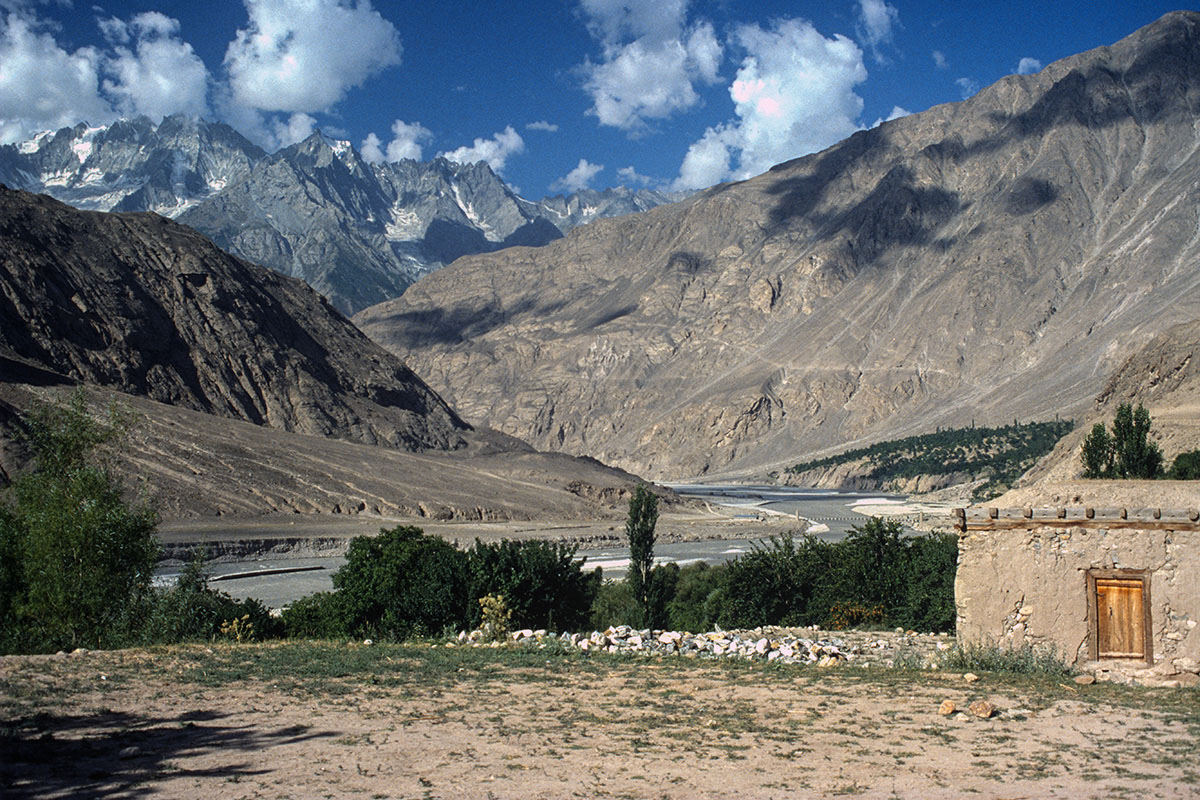
Dasso Village, Braldu Valley, Pakistan
Beyond Dasso an extension of this jeep track onward to Askole is permanently under construction; it can cut several days off the approach to Concordia and provide safer access through the Braldu Gorge. However, the hillsides across which it passes are extremely unstable and subject to frequent rockfall; when in flood, the Braldu River itself can damage bridges and neighbouring structures. Completion of a sound and reliable route through the narrowest parts of the valley will require a masterpiece of engineering. This route follows the south bank of the Braldu River and avoids most of the difficulties and is reached by a temporary bridge less than a mile east of Dasso. A further bridge is later crossed to regain access to the north bank of the river and the main trail.
If the track is incomplete then jeeps must stop at Dasso, just beyond the main bridge across the mouth of the Braldu River, and the original route followed. This climbs to, and then traverses, a ridge on the north side of the Braldu Gorge. Several narrow and crumbling paths then continue for two miles through the steepest, narrowest and notoriously dangerous part of the Braldu Gorge, crossing the river on a number of occasions . The trails cross a series of rocky outcrops and steep and unstable moraine slopes hundreds of feet high, frequently interrupted by deep gullies and prone to mudslides and stonefall.
It is wise to consult local people to establish the location of the safest route and the general condition of the gorge before any attempt is made to pass through it.
Regardless of the chosen route the difficulties and dangers of the Braldu Gorge ease at the village of Chongo where the shade of willow, poplar and apricot trees set among the fields of wheat, barley and peas provides a welcome relief from the punishing heat of the bare mountain slopes. Hot sulphur springs and intervening stalactite rock formations alternate with further areas of cultivation before the last permanent habitation is reached at Askole.
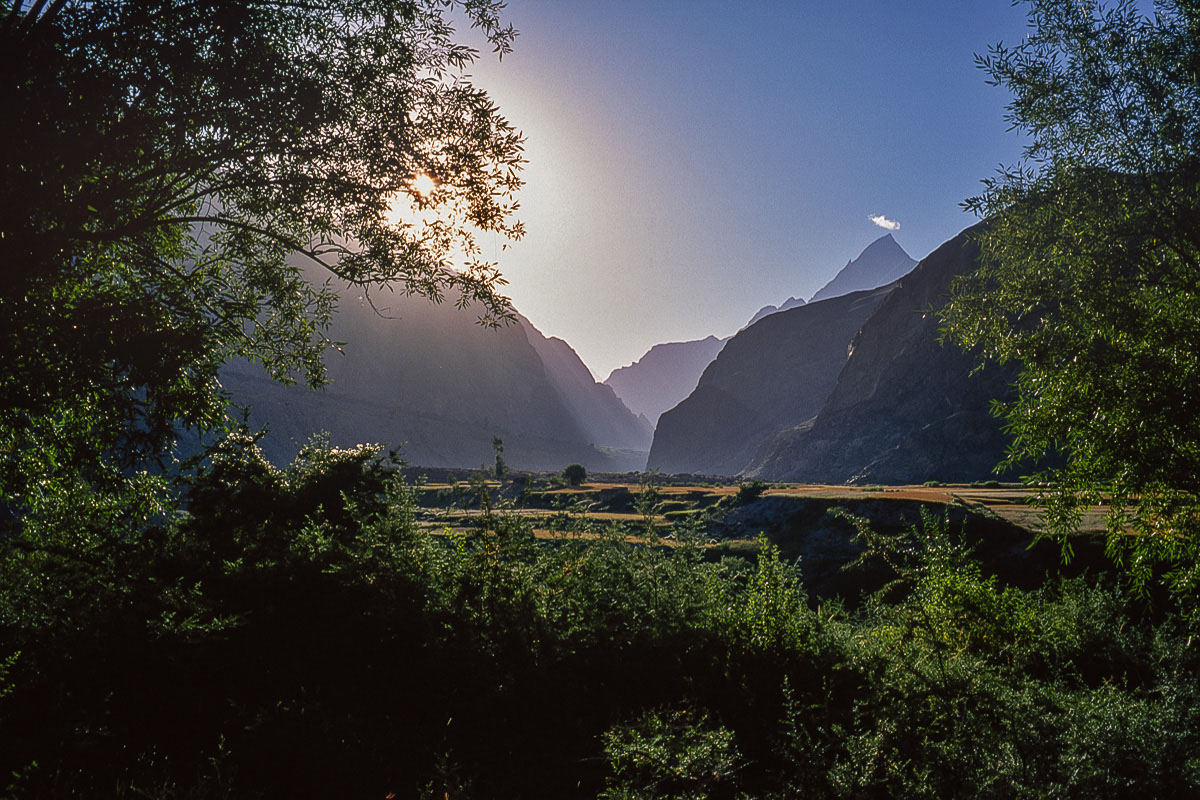
Dawn at Askole Village, Braldu Valley, Karakoram Himalaya, Pakistan
Askole is typical of so many of these mountain villages whose very existence is tenuously linked to the continued supply of water provided by the glaciers high above and channelled through intricate irrigation systems. The local inhabitants are a cheerful hardy people whose fatalistic philosophy rarely understood by those remote from them. In spite of their fierce and uncompromismg reputation and beneath their stern Moslem exterior, the Baltis are a warm and friendly people; perhaps a vestigal characteristic of their Tibetan ancestry.
The Biafo Glacier and Panmah River present the two major obstacles which stand between Askole and the snout of the Baltoro Glacier. The Biafo is reached in a few hours along a path incorporating a traverse across a vertical rock face on a log trellis covered with slates. At the very edge of the glacier, spectacular rock formations provide evidence of the enormous forces which have been, and still are at work in the mountain building process. Half a mile from its snout, a faint track crosses the glacier to reach Korophon, a pleasant campsite with shade and fresh spring water.
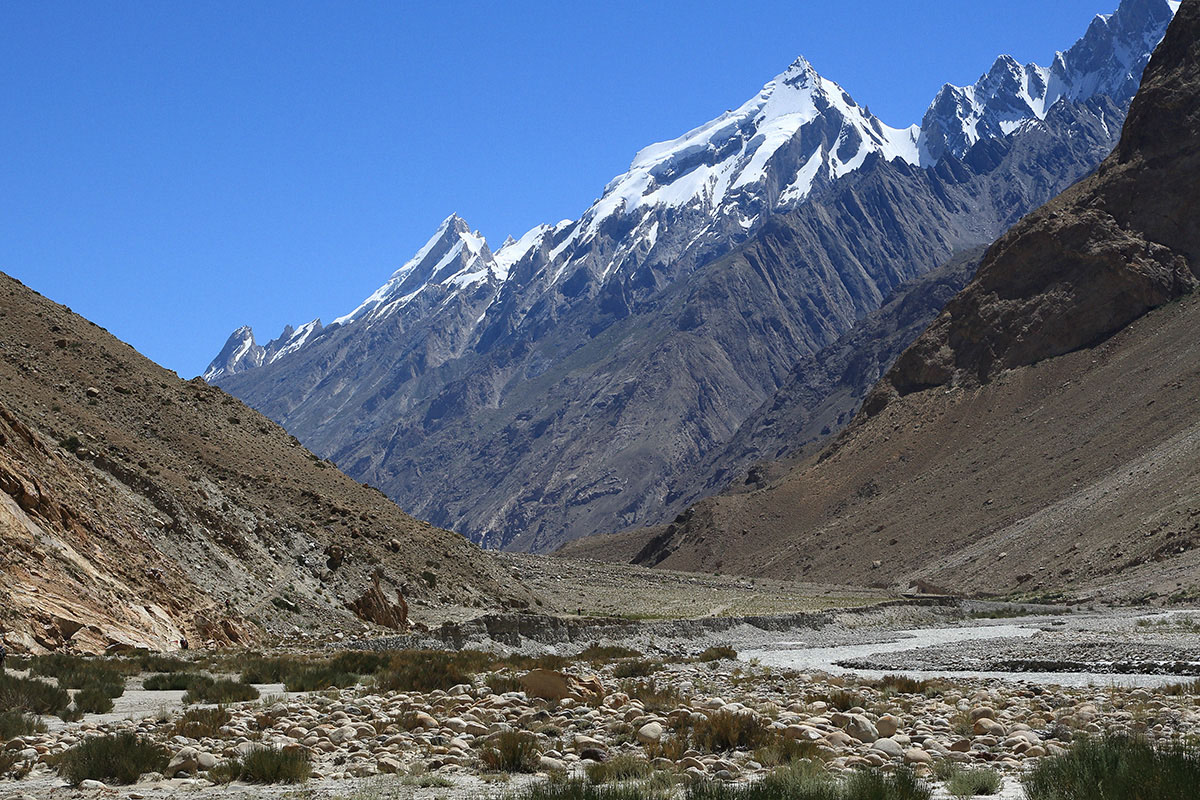
Braldumal, Braldu Valley, Karakoram Himalaya, Pakistan
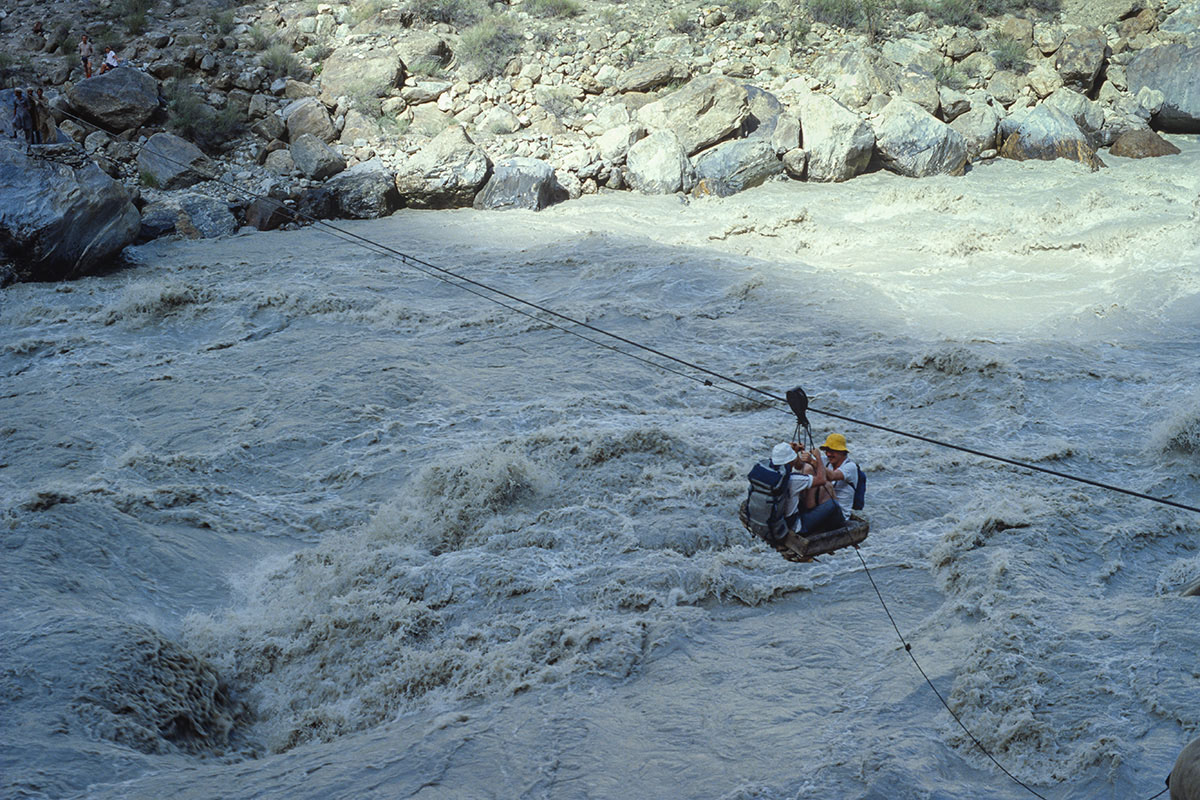
Crossing the Panmah River, Karakoram Himalayan, Pakista
Between Korophon and Paiju the path follows the north bank of the Braldu, occasionally rising to cross narrow ledges on rocky outcrops high above the river or descending to the waters edge beneath large moriane towers. A long detour follows the Panmah river upstream to the cable and box bridge at Jola.
It may be comforting to note that the sagging woven twig bridges which were so colourfully described by the early expeditions have now been replaced by box and pulley systems supported by a steel cableway. Unfortunately, the new systems suffer from a lack of maintenance and provide little reassurance to those hanging above the raging waters of the icy Braldu whilst porters struggle to pull them across. Passage across these bridges can take considerable time, depending upon the number in the party. The porters, once afraid of crossing these wild rivers, now cheerfully make the ride seated precariously on top of their loads.
Paiju camp is a bitter disappointment; talk of an alpine meadow is an exaggeration. Tents must be erected beside a stream bed on a steep tree-covered sandy slope amidst excessive quantities of litter and human excrement. This serious problem is common to all the campsites on route and a permanent solution must be found quickly if visitors are to be encouraged. Clean spring water is a rarity throughout the trek and all sources should be protected from contamination.
The view from Paiju is quite magnificent; just a mile up the valley the grey rubble of the mighty Baltoro sprawls beneath the towers of Trango and the spires of Grand Cathedral.
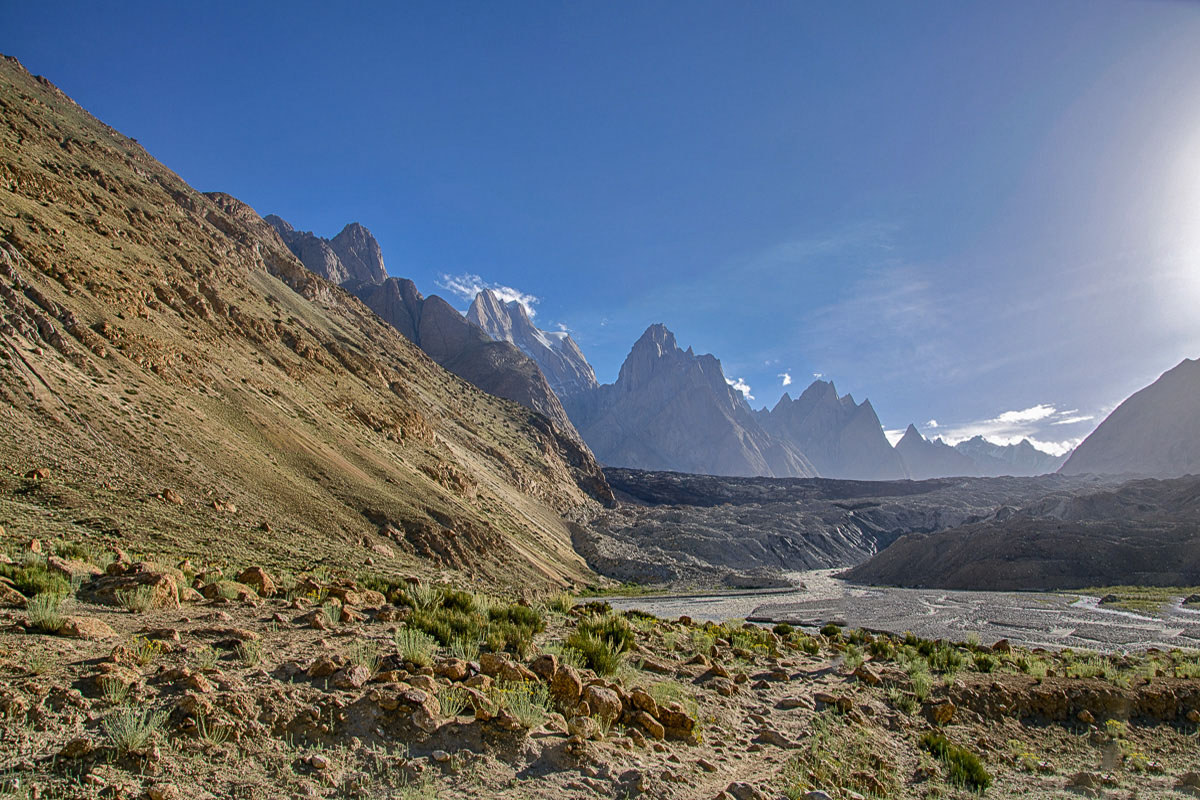
The Snout of the Baltoro Glacier from Paiju, Karakoram Himalaya, Pakistan
Setting foot on the Baltoro Glacier is a satisfying and exciting experience. With, objectively, the most difficult and dangerous part of the trip over one can look forward to mountain panoramas unrivalled anywhere in the world.
The route along the glacier is constantly changing, but essentially follows the true left bank as far as Urdukas. The views are stunning; sheer rock faces tower thousands of feet above the white, blue and grey ice of the glacier which is littered with boulders of many colours, shapes and sizes. Occasionally, boulders crash into deep blue-green pools or into enormous, seemingly bottomless chasms, through which the infant, murky-brown Braldu river roars deep beneath the glacier.
In unsettled weather Lilliwa is vulnerable to stonefall and a better campsite may be found near the river which drains the Liligo glacier a few miles beyond. Crossing this river is best accomplished in the early morning after which a pleasant walk along the Baltoro and across two small side glaciers brings one to Urdukas. Situated above the glacier on a small ledge in the mountainside, there are numerous sheltered caves here and the site is very popular with porters. It is also an excellent viewpoint for Paiju Peak, Uli Biaho, Trango Towers, Grand Cathedral Peak and Lobsang Spires.
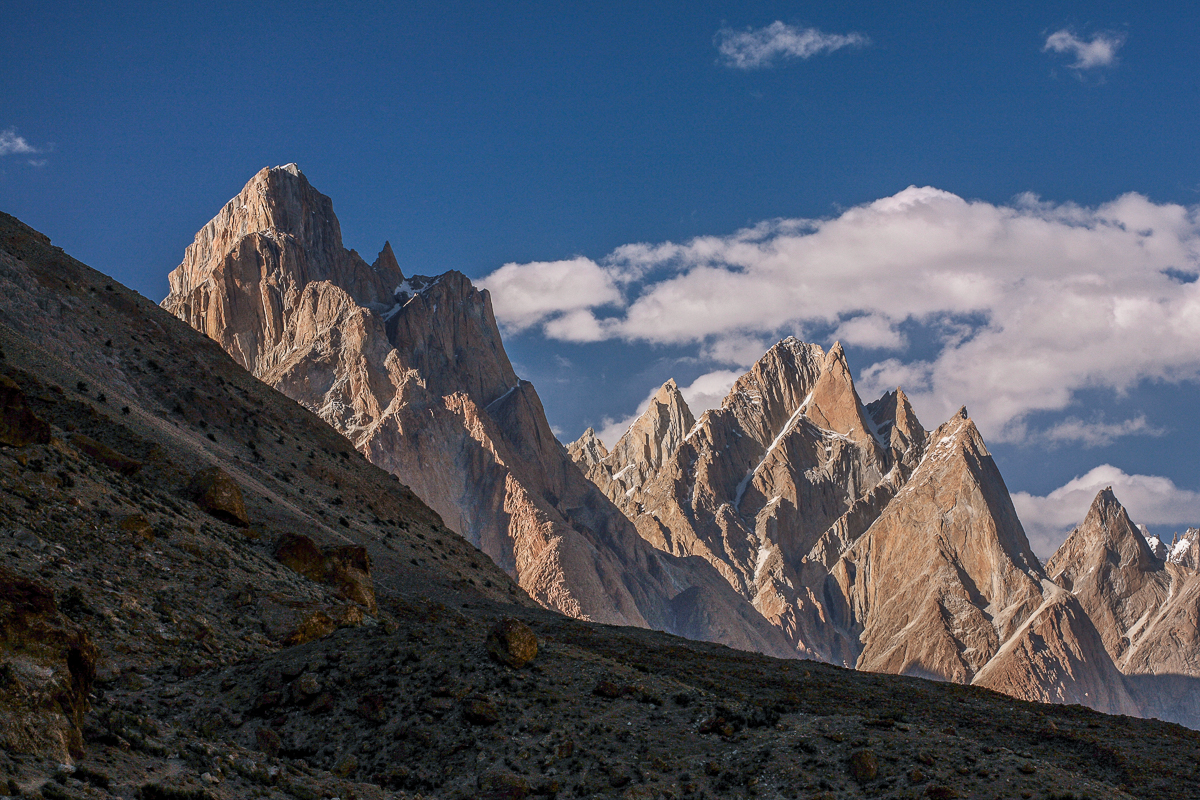
Grand Cathedral Peak, Karakoram Himalaya, Pakistan
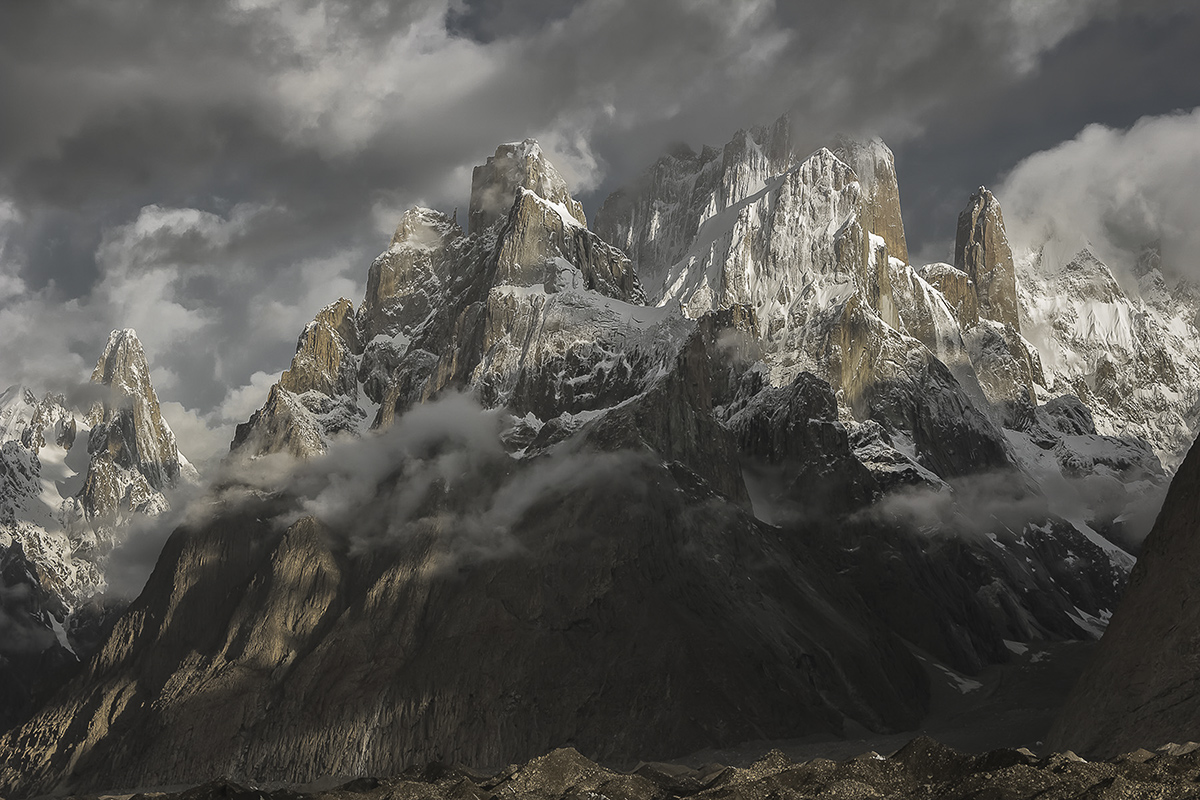
Trango Towers, Karakoram Himalaya, Pakistan
Beyond Urdukas the path strikes out for easier ground towards the centre of the glacier; here it is fairly level and covered with a dark slaty material. Concordia can be reached in a single push from Urdukas but most parties split the journey to acclimatise and to enjoy the magnificent scenery. The altitude should not be a problem as the maximum height of 4750m is usually reached in a generous ten days' walking. Goro is a highly recommended campsite, situated on the Baltoro at its confluence with the Younghusband glacier. From here Masherbrum, 7821 m, and Mustagh Tower, 7273m, present their most spectacular and precipitous faces.
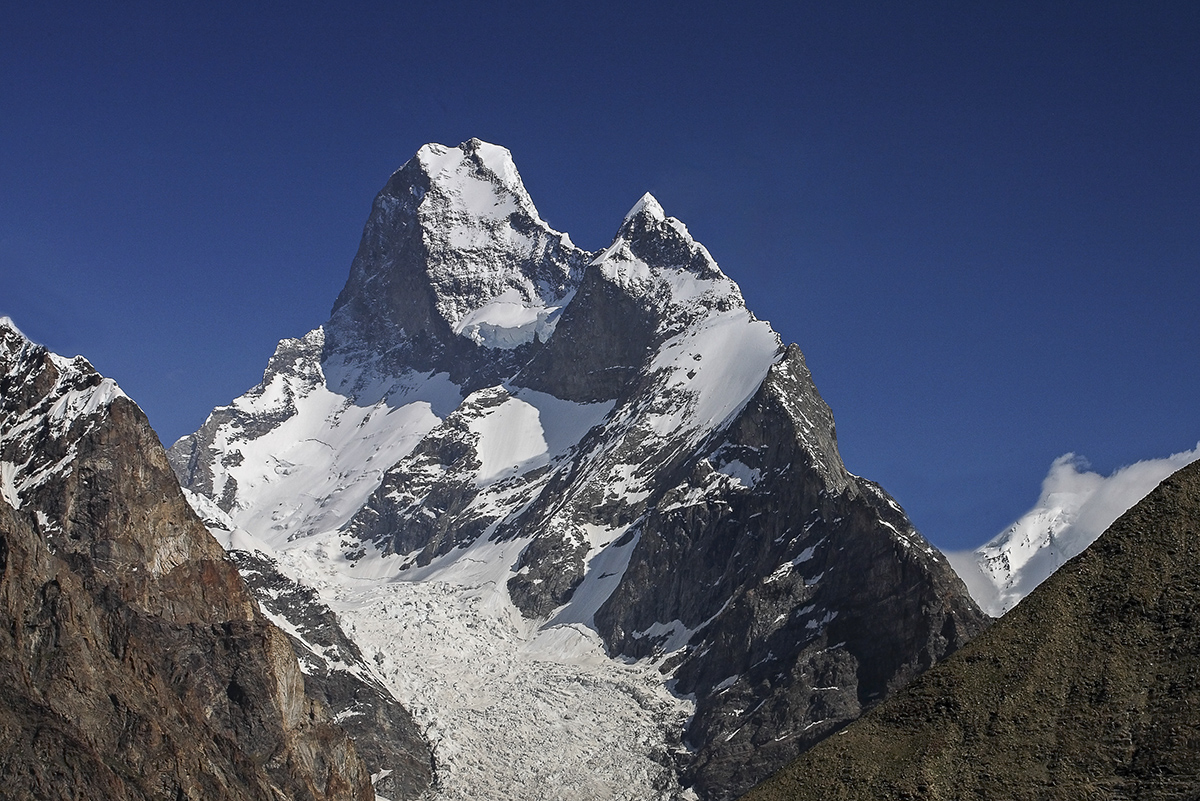
Mustagh Tower, Karakoram Himalaya, Pakistan
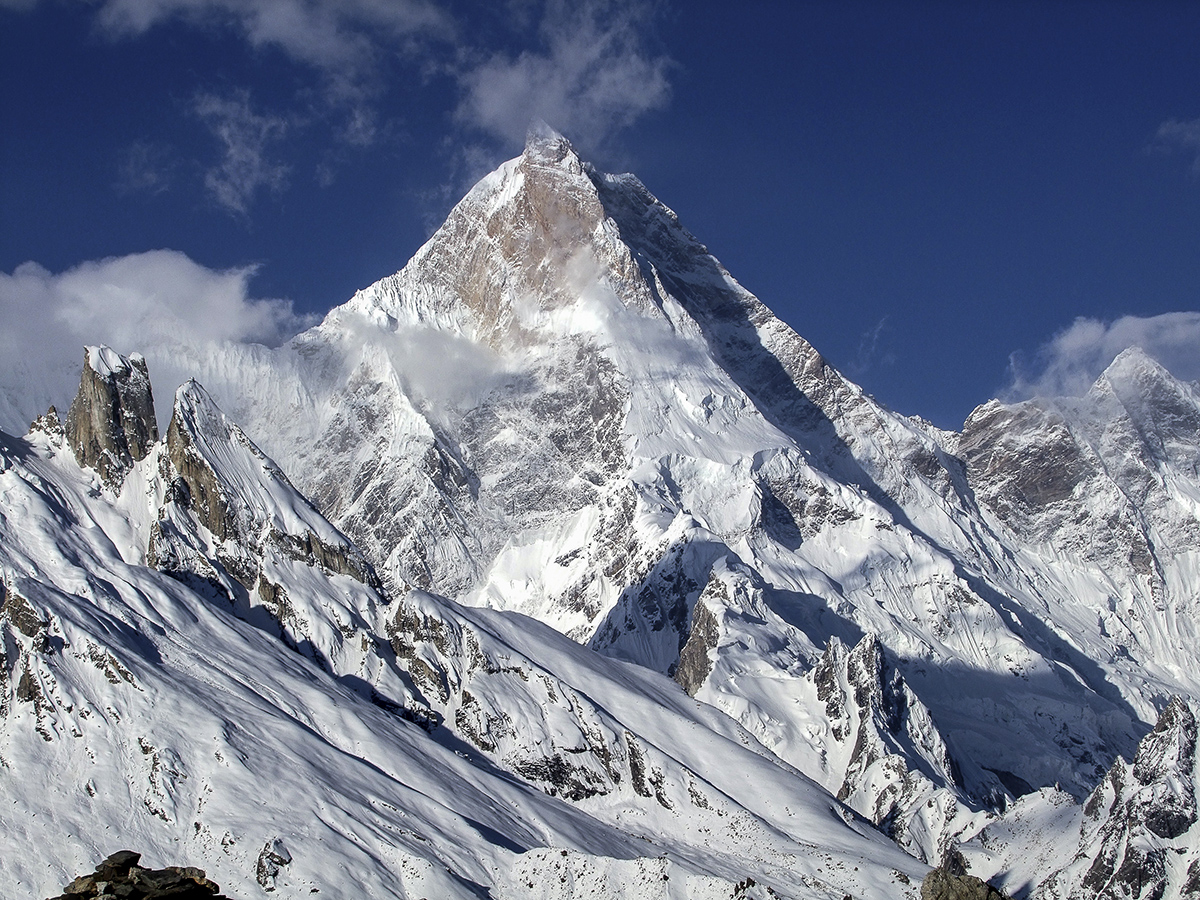
Masherbrum, Karakoram Himalaya, Pakistan
The final approach to Concordia can only be described with superlatives. Elegant spires, hanging glaciers, shining ice-covered walls, and towering peaks rise up on every side. The Gasherbrum peaks, and in particular the beautiful trapezoid of Gasherbrum 4, 7980m, completely fill the head of the valley; Crystal and Marble Peaks stand as sentinels on one side, the aptly named Mitre Peak on the other. The triple summit of mighty Broad Peak, 8047m, slowly reveals itself as Concordia is reached.
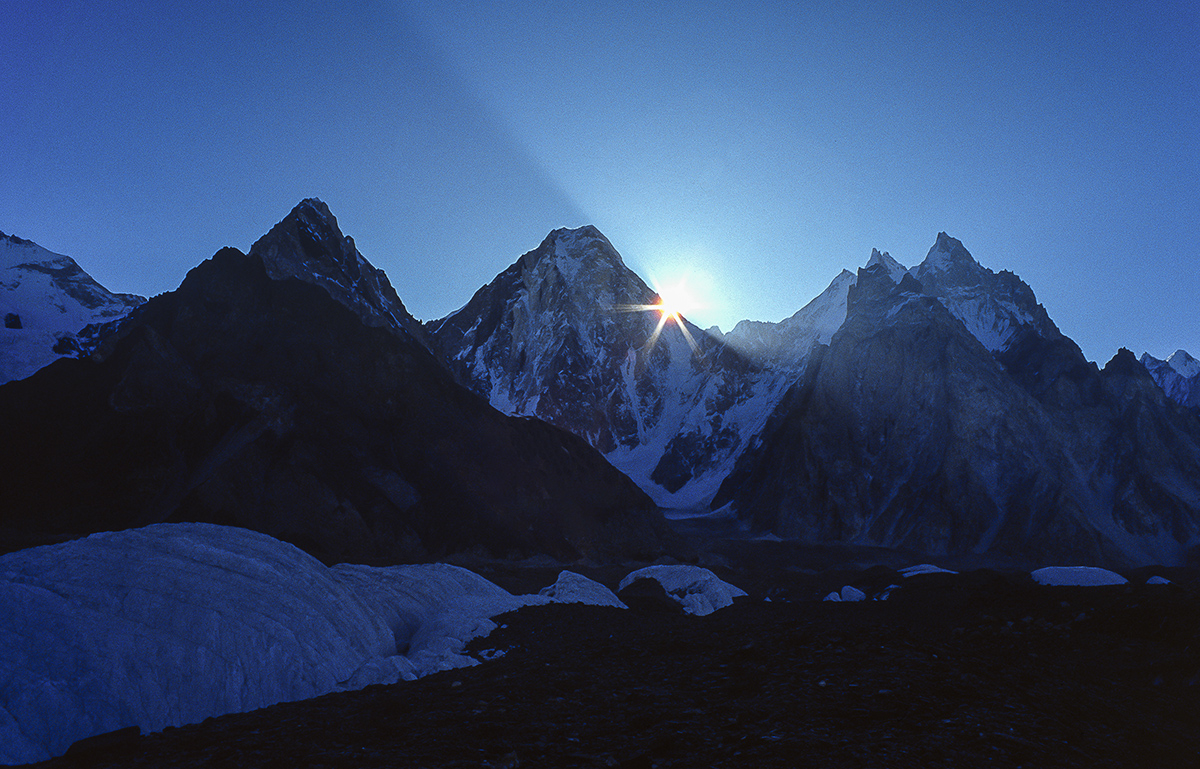
Gasherbrum Sunrise, Karakoram Himalaya, Pakistan

Broad Peak, Karakoram Himalaya, Pakistan
It is fitting that the climax of this trek is at its end. As the slopes of Marble and Mitre Peaks are passed the views up the Godwin Austen and Baltoro glaciers are finally revealed. To the south stand Baltoro Kangri or Golden Throne, 7280m, and Chogolisa or Bride Peak, 7665m, both massive snow peaks. To the north, unrivalled by any other peak and leaving no doubt as to its supremacy is K2, a perfect pyramid soaring high into the sky. The savage mountain deserves its reputation; its menacing ramparts show no lines of weakness, every route to its summit is barred by steep rock and cold ice.
Excursions to K2, Broad Peak and Chogolisa Base Camps will yield more comprehensive views of the Savoia glacier, the Gasherbrum peaks and Chogolisa. However, for trekking groups, the views of K2 from Concordia are unrivalled. It is worth staying at Concordia for a few days if only to experience its unique atmosphere and to watch the ethereal displays of cloud and light which engulf these great peaks.

K2 from Concordia, Karakoram Himalaya, Pakistan
Those who have trekked elsewhere in the Himalayas will have some measure of the scale of the country, but in many ways will find the Karakoram a very different proposition. Unlike Nepal, the area is littered with evidence of instability - splintered peaks, stonefalls and fast flowing rivers filled with glacial debris. There are vast uninhabited, desert-like wastes to cross; campsites are determined by availability rather than choice, requiring parties to be totally self-sufficient and dependent upon large armies of porters. The treks therefore tend to be long, arduous and expensive.
The views from Concordia are well worth the risks that must be taken on this difficult, sometimes dangerous, but always, classic trek. It should not be undertaken lightly, nor should it be attempted by those unprepared for some easy rock scrambling. It is perhaps best described as a mountaineer's trek; total enjoyment comes only with a knowledge of the topography and history of the area and a great love and affinity for nature's unspoilt sanctuaries.
Since writing this article, the road has now been completed to Askole and therefore avoids the need for many groups to walk the most dangerous sections of the Braldu Gorge. However, it is still subject to constant rockslide and delays and detours to the route are a constant problem. In addition, there has been considerable improvement to the track between Korophon and Paiju and many of the more hazardous sections of the route have been replaced by good paths. I am also led to believe that there is now a permanent bridge at Jola.
Finally, the increase in popularity of treks in the Karakoram and the development of its trekking industry has resulted in a much improved local service and a slight reduction in overall costs.
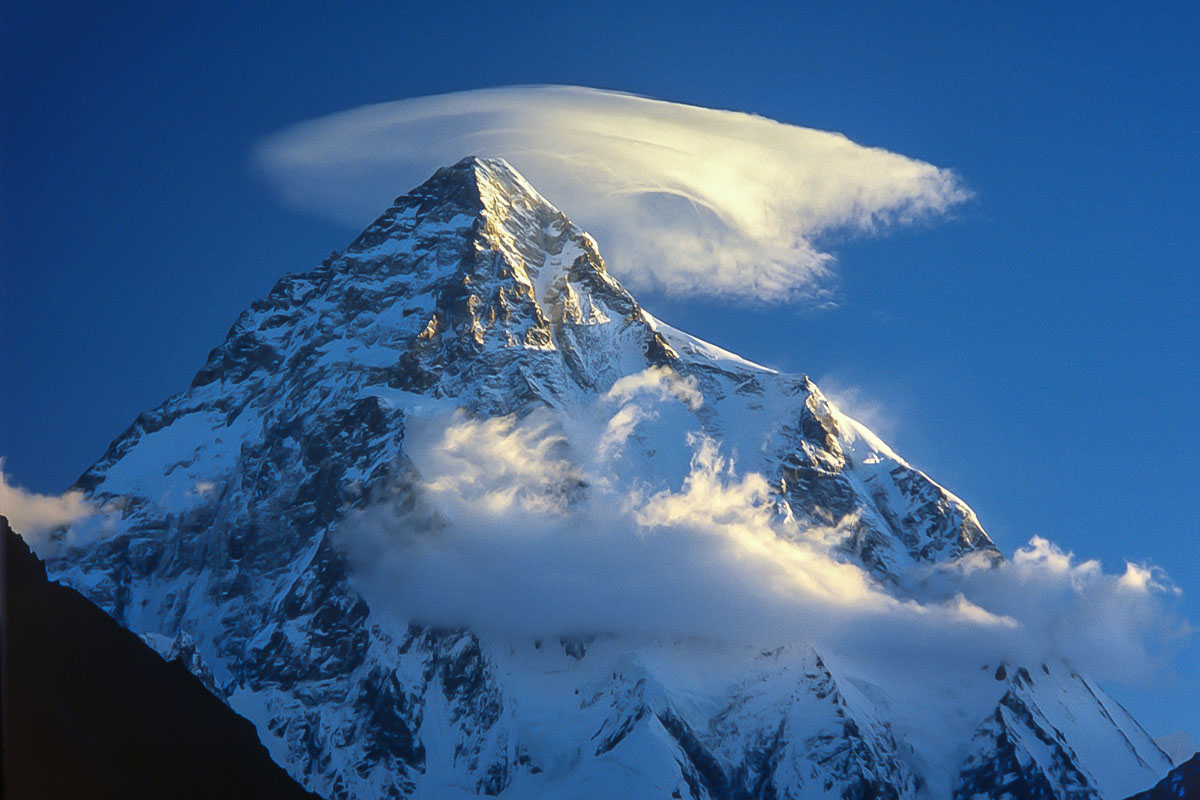
Cloud on K2 from Concordia, Karakoram Himalaya, Pakistan
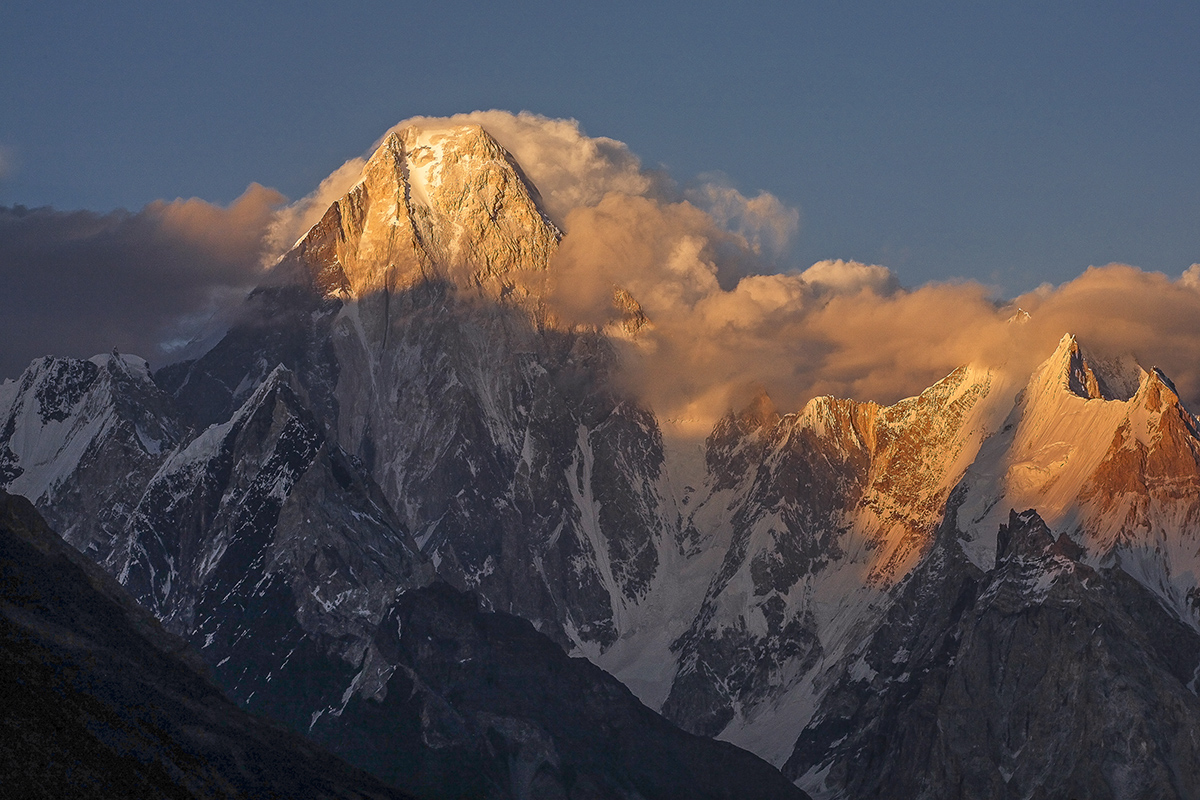
Gasherbrum 4 Sunset, Karakoram Himalaya, Pakistan